Fossaフォッサ
Cryptoprocta feroxVU— Vulnerable
The fossa is Madagascar's largest mammalian carnivore, a cat-like member of a uniquely Malagasy family of predators found only across the island's forests. More than half its diet consists of lemurs, which it hunts using powerful forelimbs and a bite to the back of the neck or throat, making it the sole predator capable of taking every lemur species. Females undergo a striking developmental quirk, temporarily developing enlarged, masculinized genitalia that recede with maturity. Habitat loss from deforestation across Madagascar has driven population declines, and the IUCN classifies the species as Vulnerable.
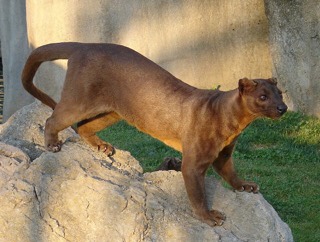 Fossa (reference photo)

Species Data
- Classification
- Carnivora / Eupleridae Source
- Size
- Head-body length about 61–80 cm, tail about 65–70 cm
- Weight
- Males about 6–12 kg, females about 5–7 kg
- Lifespan
- About 20 years in captivity (no reliable estimates are available for the wild)
- Diet
- Carnivore Carnivorous, with lemurs making up more than 50% of the diet; also eats mammals such as rodents and tenrecs, birds, reptiles, frogs, and insects. Seizes prey with its forelimbs and kills with a bite to the back of the head or throat, sometimes hunting cooperatively for large prey
- Activity
- Nocturnal but also active by day (cathemeral)
- Distribution
- The fossa is endemic to Madagascar, found throughout the island's forested habitats — dry deciduous forests, eastern rainforests, and spiny forests — at elevations from about 440 to 2,000 m. Source
- Sources
- ja.wikipedia.org en.wikipedia.org
Did You Know?
- The fossa is the largest mammalian carnivore on Madagascar and the only predator capable of hunting every living lemur species on the island. Source
- The genus name Cryptoprocta derives from ancient Greek meaning 'hidden anus,' referencing the pouch of skin that partially conceals the animal's anal glands. Source
- The fossa first arrived at a Japanese zoo in 2010, when Ueno Zoological Gardens acquired the species. Source
Where to See This Species
Operating facilities registered on this site: Japan 1
Conservation Story
Conservation Status
Vulnerable (VU)
Sources
Support Conservation
A visit is a small, positive way to support the daily lives of the animals you care about.
- Visit
- A visit itself helps support the facility.
- Animal Supporter Programs & Giving
- Find ways to support the facility through its official website.
- Furusato Nozei
- Municipally run facilities may share official guidance for this Japanese hometown-tax program.
FAQ
- What does a fossa eat?
- Lemurs make up more than half its diet, supplemented by tenrecs, rodents, birds, reptiles, and insects. It kills prey by pinning it with its forelimbs and biting the back of the neck or throat. Source
- Why is the fossa's genus name unusual?
- The genus name Cryptoprocta comes from ancient Greek for 'hidden anus,' referring to a pouch of skin that partly conceals the animal's anal scent glands. Source
- Is the fossa related to cats?
- Not directly — despite its cat-like appearance, the fossa belongs to Eupleridae, a family of carnivorans found only on Madagascar and more closely related to mongooses than to true cats. Source
- How many operating facilities are registered here?
- Operating facilities registered on this site: Japan 1 Source
Books & gear
Source: ja.wikipedia.org en.wikipedia.org