Slow Lorisスローロリス
Nycticebus coucangVU— Vulnerable
The slow loris is a small, nocturnal primate of Southeast Asia's rainforest canopy, notable as one of the very few venomous mammals—it mixes a gland secretion on its elbow with saliva to produce a toxic bite. Its slow, deliberate movement and large eyes have made it tragically popular in the illegal pet trade, where sellers often remove its teeth, leading to high mortality from infection. The Sunda slow loris is now classified as Endangered by the IUCN and listed on CITES Appendix I.
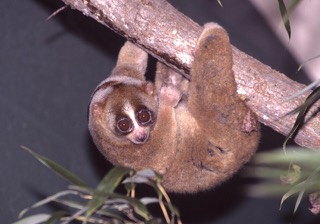 Slow Loris (reference photo)

Species Data
- Classification
- Primates / Lorisidae Source
- Size
- Head-body length about 27–38 cm
- Weight
- About 0.4–2 kg (the Sunda slow loris weighs around 599–685 g)
- Diet
- Omnivore Feeds mainly on tree gum (34.9% of feeding time), nectar (31.7%), and fruit (22.5%), along with insects, spiders, mollusks, and bird eggs; it has specialized gut bacteria for digesting gum
- Activity
- Nocturnal and arboreal; curls up to rest in dense tangles of branches during the day
- Distribution
- The Sunda slow loris is found across Sumatra, the Riau Archipelago, and the Natuna Islands in Indonesia, as well as the Malay Peninsula, southern Thailand, and Singapore, favoring rainforests with continuous dense canopy. Source
- Sources
- ja.wikipedia.org en.wikipedia.org
Did You Know?
- Slow lorises are among the few venomous primates, mixing secretions from a gland on their elbow with saliva to create a toxin that can trigger anaphylactic shock in humans who are bitten. Source
- Illegal pet trade poses a severe threat: traders often extract the teeth used to deliver venom before sale, and resulting infections carry a death rate of over 90%. Source
- True to its name, the slow loris moves with deliberate slowness, described as similar to crawling, changing direction almost silently as it navigates the canopy. Source
Where to See This Species
Operating facilities registered on this site: Japan 4
Sapporoshimaruyama DoubutsuenHokkaidoOpened in 1951
Chiba Zoological ParkChibaOpened in 1985
Higashiyama Zoo and Botanical GardensAichiOpened in 1937
Japan Monkey CentreAichiAbout a 20-minute walk from the East Exit of Meitetsu Inuyama Station (go straight along the tree-lined road for about 300 m, turn left at the Umetsubo Kosenkyo Kita intersection, and follow the road for a little over 1 km).
Former facilities
North Safari SapporoHokkaidoOpened in 2005
Closed: 2025-09-30 Official Site
- 【東山動植物園公式】スンダスローロリスの赤ちゃん(少しだけ別アングルのロングバージョン)《 スンダスローロリス スローロリス 夜行性 自然動物館 》
- スローロリスのお腹の炎症を治療中です!
- スローロリス20260731
Source links to official sites, official YouTube channels, and news aggregators such as Zoo Ring. Visit the publisher for the full item.
Conservation Story
Conservation Status
Vulnerable (VU)
Sources
Support Conservation
A visit is a small, positive way to support the daily lives of the animals you care about.
- Visit
- A visit itself helps support the facility.
- Animal Supporter Programs & Giving
- Find ways to support the facility through its official website.
- Furusato Nozei
- Municipally run facilities may share official guidance for this Japanese hometown-tax program.
FAQ
- Is the slow loris really venomous?
- Yes. It is one of the few venomous mammals, mixing a secretion from a gland on its elbow with its saliva to produce a toxic bite that can cause anaphylactic shock in humans. Source
- Why is the slow loris endangered?
- It is heavily targeted by the illegal pet trade because of its slow movements and large eyes. Traders often extract its venom-delivering teeth before sale, and infections from this practice carry a mortality rate above 90%, alongside severe habitat loss. Source
- What does the slow loris eat?
- It feeds mainly on tree sap, floral nectar, and fruit, supplemented with insects, spiders, and bird eggs, and has specialized gut bacteria that help it digest sap. Source
- How many operating facilities are registered here?
- Operating facilities registered on this site: Japan 4 Source
Books & gear
Source: ja.wikipedia.org en.wikipedia.org