African Bullfrogアフリカウシガエル
Pyxicephalus adspersusLC— Least Concern
The African bullfrog is one of the largest frog species in the world, native to the savannas and seasonal wetlands of southern and eastern Africa. An aggressive, opportunistic predator, it will eat almost anything it can overpower, including other frogs, small reptiles, birds, and mammals. To survive long dry seasons it burrows underground and forms a protective cocoon around its body, emerging explosively to breed after heavy rains, and breeding males are known to fiercely guard their tadpoles and even dig canals to keep drying pools supplied with water.
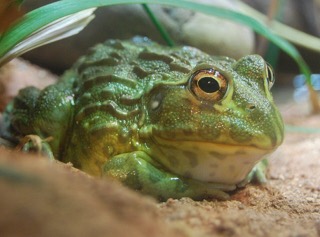 African Bullfrog (reference photo)

Species Data
- Classification
- Anura / Pyxicephalidae Source
- Size
- Body length typically 14–20 cm; males may reach 24.5 cm
- Weight
- Males up to about 1.4 kg; females weigh only about half as much as males
- Lifespan
- Said to live about 35 years in captivity
- Diet
- Carnivore Voracious carnivore that preys on insects, scorpions, other frogs, and small reptiles, birds, and mammals; cannibalism is not unusual
- Distribution
- Found across the savannas and grasslands of southern and eastern Africa, including Angola, Botswana, Kenya, Malawi, Mozambique, Namibia, South Africa, Tanzania, Uganda, Zambia, and Zimbabwe. Source
- Sources
- ja.wikipedia.org en.wikipedia.org
Did You Know?
- During dry periods it burrows into mud and forms a cocoon covering its entire body except the nostrils, emerging only once rain softens the cocoon. Source
- Breeding males actively guard their tadpoles and, if a breeding pool starts to dry up, will dig canals to channel water in from another source. Source
- It ranks as the sixth-largest living frog species, and one individual at Pretoria Zoo was recorded consuming 17 juvenile snakes. Source
Where to See This Species
Operating facilities registered on this site: Japan 1
Higashiyama Zoo and Botanical GardensAichiOpened in 1937
Former facilities
North Safari SapporoHokkaidoOpened in 2005
Closed: 2025-09-30 Official Site
Conservation Story
Conservation Status
Least Concern (LC)
Sources
Support Conservation
A visit is a small, positive way to support the daily lives of the animals you care about.
- Visit
- A visit itself helps support the facility.
- Animal Supporter Programs & Giving
- Find ways to support the facility through its official website.
- Furusato Nozei
- Municipally run facilities may share official guidance for this Japanese hometown-tax program.
FAQ
- How big does an African bullfrog get?
- Males can reach up to 24.5 cm in length and weigh as much as 1.4 kg, making it the sixth-largest frog species in the world; females are considerably smaller. Source
- How does the African bullfrog survive the dry season?
- It burrows into mud and secretes a cocoon that covers its entire body except the nostrils, remaining dormant until rainfall softens the cocoon and triggers it to emerge. Source
- Do male African bullfrogs protect their young?
- Yes—males guard tadpoles from predators after breeding, and if a pool begins drying up, they will dig canals to channel in water from another source to keep the tadpoles alive. Source
- How many operating facilities are registered here?
- Operating facilities registered on this site: Japan 1 Source
Books & gear
Source: ja.wikipedia.org en.wikipedia.org