Alligator Garアリゲーターガー
Atractosteus spatulaLC— Least Concern
The alligator gar is one of the largest freshwater fish in North America, an ancient, armor-scaled predator native to rivers and brackish coastal waters from the southern United States to northeastern Mexico. Named for its broad, alligator-like snout lined with a double row of teeth, it can breathe air using a lung-like swim bladder and is thought to live for many decades.
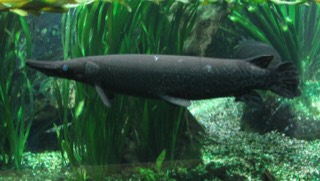 Alligator Gar (reference photo)
.jpg)
Species Data
- Classification
- Lepisosteiformes / Lepisosteidae Source
- Size
- Mature individuals are around 1.8 m in total length and said to approach 3 m at maximum; the certified record is 257.2 cm
- Weight
- Mature individuals commonly exceed 45 kg; the certified record is 148 kg
- Lifespan
- Estimated at 50–70 years in the wild, and over 95 years at the longest
- Diet
- Carnivore Mainly piscivorous ambush predator, feeding chiefly on herring-family fish and also taking waterfowl on the surface, small mammals, and turtles
- Distribution
- Native to the southern United States (Texas, Louisiana, Mississippi, and others) south into Tamaulipas and northern Veracruz, Mexico, inhabiting rivers, reservoirs, and brackish coastal waters; once ranged as far north as Kansas, Nebraska, and Ohio but is now extirpated from most of that northern range. Source
- Sources
- ja.wikipedia.org en.wikipedia.org
Did You Know?
- It has a highly vascularized swim bladder that functions like a lung, allowing it to gulp air and survive in poorly oxygenated water. Source
- Its fossil lineage traces back more than 100 million years to the Early Cretaceous, making it one of the more ancient surviving fish lineages. Source
- Spawning is triggered by rising floodwaters, and a single female can release around 150,000 eggs in one spawning event. Source
Where to See This Species
Operating facilities registered on this site: Japan 3
UOZU AQUARIUMToyamaOpened in 1913
AQUARIUM ASAMUSHIAomoriOpened in 1983
Toba AquariumMieOpened in 1955
Conservation Story
Conservation Status
Least Concern (LC)
Sources
Support Conservation
A visit is a small, positive way to support the daily lives of the animals you care about.
- Visit
- A visit itself helps support the facility.
- Animal Supporter Programs & Giving
- Find ways to support the facility through its official website.
- Furusato Nozei
- Municipally run facilities may share official guidance for this Japanese hometown-tax program.
FAQ
- How big can an alligator gar get?
- Mature individuals commonly reach about 1.8 m and over 45 kg, and the largest officially documented specimen measured 257.2 cm and weighed 148 kg. Source
- Why is the alligator gar able to survive in low-oxygen water?
- It has a highly vascularized swim bladder that acts like a lung, letting it gulp air at the surface and survive in poorly oxygenated water where most fish cannot. Source
- How many operating facilities are registered here?
- Operating facilities registered on this site: Japan 3 Source
Books & gear
Source: ja.wikipedia.org en.wikipedia.org