Arapaimaピラルクー
Arapaima gigasDD— Data Deficient
The arapaima is one of the largest freshwater fish in the world, a massive, air-breathing predator native to the Amazon and Essequibo river basins of South America. It surfaces regularly to gulp air through a lung-like swim bladder, grows to roughly a meter in its first year of life, and has become a conservation success story where community-managed fisheries have allowed populations to rebound dramatically.
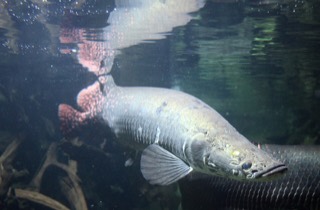 Arapaima (reference photo)

Species Data
- Classification
- Osteoglossiformes / Osteoglossidae Source
- Size
- Adults 2–3 m; claims of over 4.5 m are considered unreliable
- Weight
- Record about 200 kg
- Lifespan
- Said to live 15–20 years in captivity
- Diet
- Carnivore Carnivorous, preying mainly on small fish and shrimp, and also eating fruit, seeds, insects, and small animals near the water
- Distribution
- Native to the Amazon and Essequibo river basins of South America; populations have also been introduced to tropical regions of Asia. Source
- Sources
- ja.wikipedia.org en.wikipedia.org
Did You Know?
- It has a modified swim bladder made of lung-like tissue and breathes air at the surface, allowing it to survive in oxygen-depleted water with dissolved oxygen as low as 0.5 ppm. Source
- It grows extremely fast, with juveniles reaching about 1 meter within a single year, and a male-female pair cooperates to guard the eggs and young. Source
- Sustainable fishery management introduced in the Amazon since 1999 has helped populations in managed areas recover from about 2,500 individuals in 1999 to over 170,000 by 2017. Source
Where to See This Species
Operating facilities registered on this site: Japan 5
Kawasuikawasaki SuizokukanKanagawaRight by the East Exit of JR Kawasaki Station.
Osaka Aquarium KaiyukanOsakaOpened in 1990
Kiryuugaoka DoubutsuenGunmaIf driving, set your car navigation to "Kiryugaoka Amusement Park" (Kiryugaoka Yuenchi) rather than "Kiryugaoka Zoo" to reach the parking lot (searching by the zoo name may give an incorrect route).
Kobe Suma Sea WorldHyogoOpened in 2024
Toba AquariumMieOpened in 1955
Former facilities
Shima MarinelandMieOpened in 1970
Closed: 2021-03-31 Official Site
Conservation Story
Conservation Status
Data Deficient (DD)
Sources
Support Conservation
A visit is a small, positive way to support the daily lives of the animals you care about.
- Visit
- A visit itself helps support the facility.
- Animal Supporter Programs & Giving
- Find ways to support the facility through its official website.
- Furusato Nozei
- Municipally run facilities may share official guidance for this Japanese hometown-tax program.
FAQ
- Why does the arapaima need to come to the surface to breathe?
- It has a modified swim bladder made of lung-like tissue that lets it gulp air at the water's surface, an adaptation that allows it to survive in oxygen-poor water where gill-only breathing would not be enough. Source
- How fast does the arapaima grow?
- It is one of the fastest-growing freshwater fish, with juveniles able to reach about 1 meter in length within their first year. Source
- How many operating facilities are registered here?
- Operating facilities registered on this site: Japan 5 Source
Books & gear
Source: ja.wikipedia.org en.wikipedia.org