Brain Coralノウサンゴ
Platygyra daedaleaLC— Least Concern
Brain coral forms massive, dome-shaped colonies etched with maze-like ridges that resemble a brain, and can be surprisingly aggressive toward neighboring corals, lashing out with extra-long stinging tentacles to defend its space on the reef.
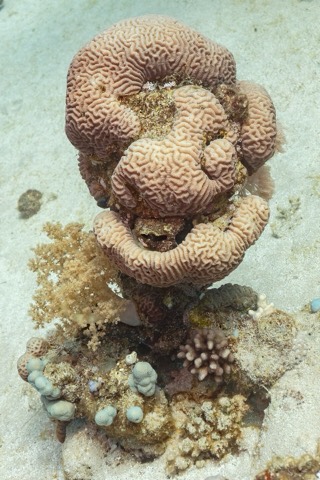 Brain Coral (reference photo)
,_parque_nacional_Ras_Muhammad,_Egipto,_2022-03-27,_DD_70.jpg)
Species Data
- Classification
- Scleractinia / Merulinidae Source
- Size
- Colonies grow in dome-shaped or massive forms and can exceed 1 m in diameter
- Diet
- Filter feeder Relies mainly on photosynthetic products from symbiotic zooxanthellae, and also extends its polyps at night to capture zooplankton
- Distribution
- Found throughout the Indo-Pacific from Madagascar and East Africa through the Red Sea to Australia, Indonesia, Japan, and the South China Sea, inhabiting reefs from the shallow subtidal zone down to about 30 m. Source
- Sources
- en.wikipedia.org
Did You Know?
- In territorial disputes with neighboring corals, it extends elongated "sweeper tentacles" up to 90 mm long — roughly 15 times normal length — armed with stinging cells to damage rival tissue. Source
- Its maze-like, valley-patterned skeleton — resembling a brain, hence the common name "brain coral" — is distinguished from closely related species by features such as the shape of its central ridge (columella). Source
Where to See This Species
Operating facilities registered on this site: Japan 0
Verified individual animals and facilities will be added as official information becomes available.
Conservation Story
Conservation Status
Least Concern (LC)
Sources
Support Conservation
A visit is a small, positive way to support the daily lives of the animals you care about.
- Visit
- A visit itself helps support the facility.
- Animal Supporter Programs & Giving
- Find ways to support the facility through its official website.
FAQ
- Why does brain coral have a maze-like pattern?
- Its skeleton grows in meandering valleys with a central ridge (columella) and toothed walls, creating the brain-like grooved surface that gives the coral its common name. Source
- Does brain coral compete with other corals?
- Yes. It can grow "sweeper tentacles" up to about 90 mm long — far longer than its normal tentacles — to sting and damage the tissue of encroaching neighboring corals. Source
- How does brain coral get its food?
- Most of its energy comes from photosynthetic algae living in its tissue, supplemented by plankton captured with its polyps at night. Source
- How many operating facilities are registered here?
- Operating facilities registered on this site: Japan 0 Source
Books & gear
Source: ja.wikipedia.org en.wikipedia.org