Cotton-top Tamarinワタボウシタマリン
Saguinus oedipusCR— Critically Endangered
The cotton-top tamarin is a small primate endemic to a narrow strip of forest in northwestern Colombia, instantly recognizable by its flowing crest of white hair. It feeds on a roughly even mix of fruit and animal prey such as insects, and lives in close-knit family groups within a home range of just 8 to 10 hectares. Habitat destruction has reduced its forest to a fraction of its historical range, and with a wild population estimated at around 6,000 individuals (about 2,000 of them mature), the IUCN classifies it as Critically Endangered.
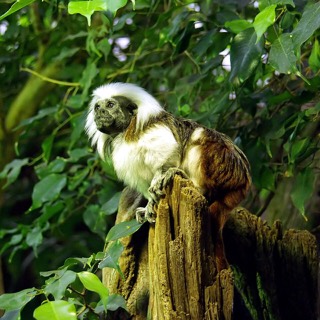 Cotton-top Tamarin (reference photo)

Species Data
- Classification
- Primates / Callitrichidae Source
- Size
- Head-body length about 20.8–30 cm, tail about 33–41 cm
- Weight
- About 400–600 g (average around 432 g)
- Lifespan
- Wild: about 13 years; captive: up to about 24 years
- Diet
- Omnivore Omnivorous, eating insects, tree gum, flowers, and fruit; fruit (about 40%) and animal matter such as insects (about 40%) make up roughly equal shares, and it sometimes preys on reptiles and amphibians
- Activity
- Diurnal and arboreal, ranging over a home range of about 8–10 hectares
- Distribution
- The cotton-top tamarin is restricted to a small area of northwestern Colombia, bounded by the Cauca and Magdalena rivers to the south and east, the Atlantic coast to the north, and the Atrato River to the west. Source
- Sources
- ja.wikipedia.org en.wikipedia.org
Did You Know?
- The species is named for the long crest of white hair flowing from its forehead to its shoulders, which in German gave rise to the nickname 'Lisztaffe' (Liszt monkey), after the composer's distinctive hairstyle. Source
- Before CITES protection began in 1976, as many as 40,000 cotton-top tamarins were captured for biomedical research. Source
- The lowland forest it depends on has been reduced to just 5% of its historical extent, and the species is listed among the world's 25 most endangered primates. Source
Where to See This Species
Operating facilities registered on this site: Japan 4
Ishikawa DoubutsuenIshikawaAbout 60 minutes from the Kanazawa-Morimoto Interchange on the Hokuriku Expressway, about 40 minutes from the Kanazawa-Nishi Interchange, and about 20 minutes from the Komatsu Interchange.
Noichi Zoological Park of Kochi PrefectureKochiA 20-minute walk or 13-minute rental-bicycle ride from Noichi Station on the Tosa Kuroshio Railway Gomen-Nahari Line.
Chiba Zoological ParkChibaOpened in 1985
Hamamatsu Zoological GardensShizuokaOpened in 1950
Conservation Story
Conservation Status
Critically Endangered (CR)
Sources
Support Conservation
A visit is a small, positive way to support the daily lives of the animals you care about.
- Visit
- A visit itself helps support the facility.
- Animal Supporter Programs & Giving
- Find ways to support the facility through its official website.
- Furusato Nozei
- Municipally run facilities may share official guidance for this Japanese hometown-tax program.
FAQ
- Why is the cotton-top tamarin critically endangered?
- The lowland forest it depends on in northwestern Colombia has been reduced to about 5% of its historical range through deforestation, and the species was also heavily captured for biomedical research before CITES protection began in 1976. The IUCN now estimates around 6,000 individuals remain in the wild. Source
- Where do cotton-top tamarins live?
- They are endemic to a restricted area of northwestern Colombia, bounded by the Cauca and Magdalena rivers, the Atlantic coast, and the Atrato River. Source
- What does a cotton-top tamarin eat?
- Its diet is roughly split between fruit (about 40%) and animal matter such as insects (about 40%), with plant exudates and occasional small reptiles or amphibians making up the rest. Source
- How many operating facilities are registered here?
- Operating facilities registered on this site: Japan 4 Source
Books & gear
Source: ja.wikipedia.org en.wikipedia.org