Eurasian Eagle-owlワシミミズク
Bubo buboLC— Least Concern
The Eurasian eagle-owl is one of the largest owl species in the world, a powerful nocturnal predator found across most of Eurasia. Unusually among owls, it hunts more by sight than by sound, and it has shown a striking ability to adapt to urban environments in cities like Helsinki.
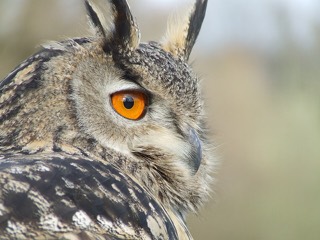 Eurasian Eagle-owl (reference photo)

Species Data
- Classification
- Strigiformes / Strigidae Source
- Size
- 56–75 cm
- Weight
- Females 1.75–4.6 kg, males 1.2–3.2 kg
- Lifespan
- Wild record of 27 years 9 months; one captive bird lived 68 years
- Diet
- Carnivore Preys on mammals such as rodents and hares and on birds such as herons, buzzards, and other owls; also eats reptiles, frogs, and insects
- Distribution
- Widespread across Eurasia, with a total range of about 51.4 million km², from the Iberian Peninsula to the Russian Far East. Source
- Sources
- ja.wikipedia.org en.wikipedia.org
Did You Know?
- Unlike many owls, it has a relatively simple ear structure and shallow facial disc, so it relies more on vision than hearing when hunting. Source
- In Helsinki, five pairs have nested within the city since 2005, and in 2007 one individual that appeared at the Olympic Stadium—nicknamed "Bubi"—was voted "Helsinki Citizen of the Year." Source
Where to See This Species
Operating facilities registered on this site: Japan 4
Kyoto City ZooKyotoOpened in 1903
Tennoji ZooOsakaOpened in 1915
Hamamatsu Zoological GardensShizuokaOpened in 1950
Fukuoka Zoo & Botanical GardenFukuokaOpened in 1953
Former facilities
North Safari SapporoHokkaidoOpened in 2005
Closed: 2025-09-30 Official Site
Conservation Story
Conservation Status
Least Concern (LC)
Sources
Support Conservation
A visit is a small, positive way to support the daily lives of the animals you care about.
- Visit
- A visit itself helps support the facility.
- Animal Supporter Programs & Giving
- Find ways to support the facility through its official website.
- Furusato Nozei
- Municipally run facilities may share official guidance for this Japanese hometown-tax program.
FAQ
- How big is the Eurasian eagle-owl?
- It is one of the largest owl species, with a body length of 56–75 cm, a wingspan up to nearly 2 m, and females weighing up to 4.6 kg. Source
- What does the Eurasian eagle-owl eat?
- It preys mainly on rodents, hares, and other mammals, but also takes birds—including herons and other raptors—as well as reptiles, amphibians, and insects. Source
- How many operating facilities are registered here?
- Operating facilities registered on this site: Japan 4 Source
Books & gear
Source: ja.wikipedia.org en.wikipedia.org