Flower Hat Jellyハナガサクラゲ
Olindias formosusNE— Not Evaluated
The flower hat jelly is a striking jellyfish from the northwestern Pacific, named for its coiled, fluorescent-tipped tentacles that resemble a flower-shaped hat. It rests on the seafloor by day and rises to hunt small fish at night, delivering a sting that is painful but not considered life-threatening under normal circumstances.
Operating facilities registered on this site: Japan 1 (Niigata City Aquarium). These facilities are confirmed by resident animal records or the facility’s official information.
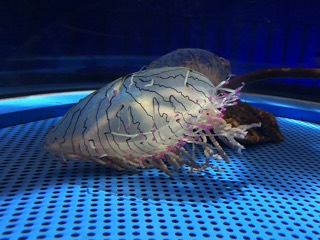 Flower Hat Jelly (reference photo)

Species Data
- Classification
- Limnomedusae / Olindiidae Source
- Size
- Bell diameter about 10–15 cm in adults
- Diet
- Carnivore Paralyzes small fish with the venom of its tentacle stinging cells and swallows them whole
- Activity
- Rests motionless on the bottom in the shade of rocks by day, rising at night to swim and hunt
- Distribution
- Found in the northwestern Pacific off central and southern Japan and Jeju Island, South Korea, as well as coastal waters of Brazil and Argentina. Source
- Sources
- ja.wikipedia.org en.wikipedia.org
Did You Know?
- The species name formosa is Latin for "beautiful," and the jelly's graceful swimming inspired its Japanese name, which likens it to the traditional "hanagasa" flower-hat dance. Source
- The tips of its tentacles glow with fluorescent yellow-green or pink hues, thought to lure small fish within striking range. Source
- It has been observed grasping small pebbles with its tentacles to weigh itself down and resist being swept away by currents. Source
Where to See This Species
Operating facilities registered on this site: Japan 1
Niigata City AquariumNiigataOpened in 1990
Possible records, not yet confirmed: 3
These facilities are not confirmed by an official animal list. They appear in secondary sources such as Wikipedia; check the facility’s official website for current exhibits.
Osaka Aquarium KaiyukanOsakaOpened in 1990
(Not confirmed by official sources) Source
KAMO AQUARIUMYamagataFrom JR Tsuruoka Station, take the Shonai Airport shuttle bus bound for Yunohama Onsen for about 40 minutes and get off at "Kamo Suizokukan"; the aquarium is right there (note that buses via Zenpoji do not stop here).
(Not confirmed by official sources) Source
Monterey Bay AquariumOpened in 1984
(Not confirmed by official sources) Source
Former facilities
Marinepia Matsushima AquariumMiyagiOpened in 1927
(Not confirmed by official sources) Source
Closed: 2015-05-10 Official Site
Conservation Story
Conservation Status
Not Evaluated (NE)
Sources
Support Conservation
A visit is a small, positive way to support the daily lives of the animals you care about.
- Visit
- A visit itself helps support the facility.
- Animal Supporter Programs & Giving
- Find ways to support the facility through its official website.
- Furusato Nozei
- Municipally run facilities may share official guidance for this Japanese hometown-tax program.
FAQ
- Where can I see Flower Hat Jelly in Japan?
- Operating facilities registered on this site: Japan 1 (Niigata City Aquarium). These facilities are confirmed by resident animal records or the facility’s official information. Source
- How big does a flower hat jelly get?
- Its bell typically reaches about 10-15 cm (4-6 in) in diameter at maturity. Source
- Is the flower hat jelly dangerous to humans?
- Its sting delivers a painful, burning sensation, but it is not considered a serious threat to humans under normal circumstances. Source
- Where does the flower hat jelly live?
- It is found in the northwestern Pacific along central and southern Japan and Jeju Island, South Korea, and also occurs off Brazil and Argentina, usually resting on rocky or algae-covered seabeds during the day. Source
Books & gear
Source: ja.wikipedia.org en.wikipedia.org