Freshwater Angelfishエンゼルフィッシュ
Pterophyllum scalareLC— Least Concern
The freshwater angelfish is a tall, laterally flattened cichlid native to slow-moving rivers and flooded forests of the Amazon Basin, instantly recognizable by its long trailing fins. It is the most widely kept angelfish species in the aquarium trade, forms monogamous breeding pairs that guard their eggs together, and has even had its full genome sequenced.
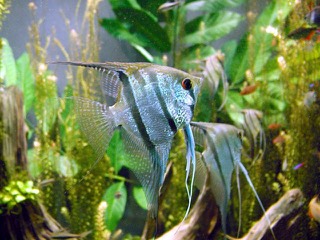 Freshwater Angelfish (reference photo)

Species Data
- Classification
- Cichliformes / Cichlidae Source
- Size
- Total length about 12–15 cm
- Diet
- Carnivore Carnivorous, preying on insects, mollusks, crustaceans, tubifex worms, fish eggs, and small fish
- Distribution
- Native to the Amazon Basin of Peru, Colombia, and Brazil, inhabiting swamps and flooded areas with dense vegetation along slow-moving rivers. Source
- Sources
- ja.wikipedia.org en.wikipedia.org
Did You Know?
- During spawning, a pair lays around 1,000 small eggs arranged in a circle on a leaf or piece of driftwood, and both parents guard the eggs and fry, though they sometimes end up eating their own young. Source
- It is the species of angelfish most frequently found in the aquarium trade, and in 2022 its genome was sequenced and assembled by high school student Indeever Madireddy. Source
Where to See This Species
Operating facilities registered on this site: Japan 1
Osaka Aquarium KaiyukanOsakaOpened in 1990
Conservation Story
Conservation Status
Least Concern (LC)
Sources
Support Conservation
A visit is a small, positive way to support the daily lives of the animals you care about.
- Visit
- A visit itself helps support the facility.
- Animal Supporter Programs & Giving
- Find ways to support the facility through its official website.
- Furusato Nozei
- Municipally run facilities may share official guidance for this Japanese hometown-tax program.
FAQ
- Why does the freshwater angelfish have such a distinctive shape?
- Its body is strongly compressed laterally and paired with long, trailing dorsal and anal fins, an adaptation that lets it slip vertically between plant stems in its native flooded forest habitat. Source
- How do freshwater angelfish care for their eggs?
- A breeding pair lays around 1,000 eggs arranged in a circle on a leaf or piece of driftwood, and both parents take turns guarding the eggs and the fry after they hatch. Source
- How many operating facilities are registered here?
- Operating facilities registered on this site: Japan 1 Source
Books & gear
Source: ja.wikipedia.org en.wikipedia.org