Galápagos Tortoiseガラパゴスゾウガメ
Chelonoidis nigerVU— Vulnerable
The Galápagos tortoise is the largest living tortoise and the largest extant terrestrial cold-blooded animal, endemic to seven islands of the Galápagos archipelago, each with its own subspecies. It feeds on cacti, grasses, and other vegetation, storing enough water to survive over six months without drinking, and can live well over a century. Overexploitation reduced the population from roughly 250,000 in the 16th century to about 15,000 by the 1970s, and it is now assessed as Vulnerable by the IUCN.
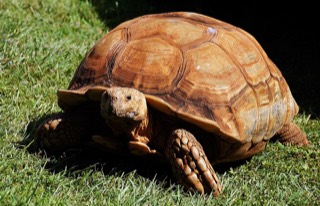 Galápagos Tortoise (reference photo)
.jpg)
Species Data
- Classification
- Testudines / Testudinidae Source
- Size
- Carapace length up to about 187 cm; among the largest living tortoises
- Weight
- Up to about 417 kg
- Lifespan
- Said to live over 100 years in the wild, with a captive record exceeding 170 years
- Diet
- Herbivore Herbivorous, eating succulents including cacti, herbs, lichens, and fruit
- Distribution
- Native to seven of the Galápagos Islands, Ecuador, with distinct subspecies inhabiting specific islands or volcanoes; the islands themselves are named after the Spanish word for tortoise, "galápago." Source
- Sources
- ja.wikipedia.org en.wikipedia.org
Did You Know?
- It is the largest living terrestrial cold-blooded animal, with shell shape varying between "domed" and "saddleback" forms depending on the island. Source
- During his 1835 visit, Charles Darwin noticed that shell shape varied from island to island, an observation that contributed to his later theory of natural selection. Source
Where to See This Species
Operating facilities registered on this site: Japan 1
Conservation Story
Conservation Status
Vulnerable (VU)
Sources
Support Conservation
A visit is a small, positive way to support the daily lives of the animals you care about.
- Visit
- A visit itself helps support the facility.
- Animal Supporter Programs & Giving
- Find ways to support the facility through its official website.
- Furusato Nozei
- Municipally run facilities may share official guidance for this Japanese hometown-tax program.
FAQ
- How long do Galápagos tortoises live?
- They commonly live over 100 years in the wild, and captive individuals have been documented living past 170 years. Source
- How did Galápagos tortoises influence Charles Darwin?
- Darwin observed in 1835 that tortoises on different islands had differently shaped shells, an insight that fed into his development of the theory of natural selection. Source
- How many operating facilities are registered here?
- Operating facilities registered on this site: Japan 1 Source
Books & gear
Source: ja.wikipedia.org en.wikipedia.org