Giant Isopodダイオウグソクムシ
Bathynomus giganteusNE— Not Evaluated
The giant isopod is one of the largest deep-sea crustaceans known, dwelling on the seafloor of the Gulf of Mexico and western Atlantic at depths of 200-1,000 m. A scavenger that feeds on the carcasses of large fish and whales, it is famous for surviving extreme fasting, including one Toba Aquarium specimen that went without food for over five years.
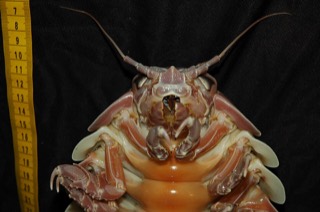 Giant Isopod (reference photo)

Species Data
- Classification
- Isopoda / Cirolanidae Source
- Size
- Body length 20–40 cm; large individuals approach 50 cm
- Weight
- Some individuals exceed 1 kg
- Lifespan
- Estimated at about 7.7 years for females and about 6 years for males
- Diet
- Carnivore A "scavenger of the deep" that feeds on the carcasses of large fish, whales, and other animals that sink to the seafloor
- Distribution
- Native to the deep seafloor of the Gulf of Mexico and the western Atlantic, typically at depths of 200-1,000 m. Source
- Sources
- ja.wikipedia.org en.wikipedia.org
Did You Know?
- Its compound eyes are made up of roughly 3,500 individual facets, among the largest compound eyes known in arthropods. Source
- An individual known as "No. 1" kept at Toba Aquarium famously went without eating for five years and one month (1,869 days), from January 2009 to February 2014. Source
- It is frequently cited alongside the giant squid as a classic example of deep-sea gigantism. Source
Where to See This Species
Operating facilities registered on this site: Japan 3
Toba AquariumMieOpened in 1955
ENOSHIMA AQUARIUMKanagawaOpened in 2004
Conservation Story
Conservation Status
Not Evaluated (NE)
Sources
Support Conservation
A visit is a small, positive way to support the daily lives of the animals you care about.
- Visit
- A visit itself helps support the facility.
- Animal Supporter Programs & Giving
- Find ways to support the facility through its official website.
- Furusato Nozei
- Municipally run facilities may share official guidance for this Japanese hometown-tax program.
FAQ
- How long can a giant isopod go without eating?
- They are remarkably tolerant of starvation; one individual at Toba Aquarium in Japan went 1,869 days (about five years and one month) without eating. Source
- What does a giant isopod eat?
- It is a deep-sea scavenger that mainly feeds on the carcasses of large fish, whales, and squid that sink to the seafloor. Source
- How deep does the giant isopod live?
- It typically inhabits depths of about 200 to 1,000 m on the muddy, sandy floor of the Gulf of Mexico and the western Atlantic. Source
- How many operating facilities are registered here?
- Operating facilities registered on this site: Japan 3 Source