Giant Stag Beetleオオクワガタ
Dorcus hopeiNE— Not Evaluated
The giant stag beetle is one of Japan's most iconic beetles, prized for its powerful mandibles and unusually long adult lifespan of several years. Native to old-growth forests from southwestern Hokkaido to Kyushu, it became the symbol of Japan's stag-beetle collecting boom thanks to well-developed captive breeding techniques.
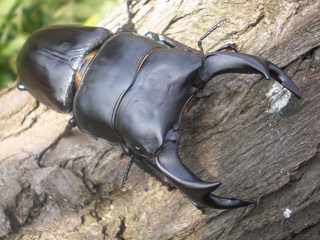 Giant Stag Beetle (reference photo)

Species Data
- Classification
- Coleoptera / Lucanidae Source
- Size
- Males 40–94.1 mm, females 25–61.5 mm (the captive record for a male is 94.1 mm)
- Lifespan
- Adults commonly live 5–6 years in captivity, and a Guinness record documents one surviving 7 years
- Diet
- Herbivore Adults gather at the sap of broadleaf trees; larvae grow by eating rotting wood
- Activity
- Nocturnal (hides deep in tree hollows by day and emerges at night in search of sap)
- Distribution
- The Japanese subspecies (Dorcus hopei binodulosus) ranges from southwestern Hokkaido to Kyushu, including Tsushima Island, inhabiting old-growth beech forests and oak woodlands in scattered locations. Source
- Sources
- ja.wikipedia.org en.wikipedia.org
Did You Know?
- With its sturdy legs and powerful mandibles, it is regarded as one of the most formidable fighters among Japan's native stag beetles. Source
- Well-established captive breeding techniques made it the flagship species of Japan's stag beetle boom in the late 1990s, and selective breeding produced an individual exceeding 90 mm by 2016. Source
- It is reported to possess antifreeze proteins not found in related species, allowing it to survive extended periods at temperatures as low as -15°C. Source
Where to See This Species
Operating facilities registered on this site: Japan 0
Verified individual animals and facilities will be added as official information becomes available.
Conservation Story
Conservation Status
Not Evaluated (NE)
Sources
Support Conservation
A visit is a small, positive way to support the daily lives of the animals you care about.
- Visit
- A visit itself helps support the facility.
- Animal Supporter Programs & Giving
- Find ways to support the facility through its official website.
FAQ
- How long do giant stag beetles live as adults?
- Adults commonly live 5-6 years in captivity, unusually long for a beetle, with a Guinness-recognized record of 7 years. Source
- Where in Japan is the giant stag beetle found?
- The Japanese subspecies occurs from southwestern Hokkaido to Kyushu, including Tsushima Island, favoring old-growth beech and oak forests. Source
- Why is this species popular with breeders?
- Its captive-breeding methods are well established, and selective breeding by hobbyists has produced individuals over 90 mm long, driving a major collecting boom in Japan since the late 1990s. Source
- How many operating facilities are registered here?
- Operating facilities registered on this site: Japan 0 Source
Books & gear
Source: ja.wikipedia.org en.wikipedia.org