Great Hornbillオオサイチョウ
Buceros bicornisVU— Vulnerable
The great hornbill is one of the largest hornbill species, a striking forest bird of South and Southeast Asia known for its massive yellow-and-black casque atop the bill. Its unusual breeding behavior—sealing the female inside a tree cavity for weeks of dependent incubation—makes it one of the more remarkable nesting strategies in the bird world.
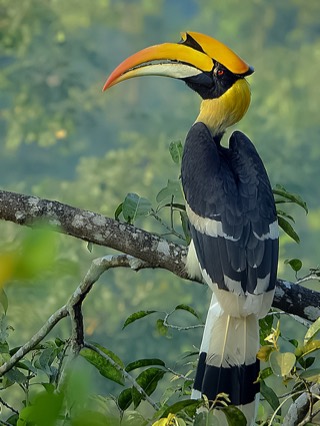 Great Hornbill (reference photo)

Species Data
- Classification
- Bucerotiformes / Bucerotidae Source
- Size
- 90–130 cm
- Weight
- 2–4 kg (males average about 3 kg, females about 2.59 kg)
- Lifespan
- One captive bird lived nearly 50 years
- Diet
- Omnivore Feeds mainly on fruit (especially figs), and also preys on small mammals, reptiles, birds, and insects; obtains nearly all its water from fruit
- Distribution
- Native to forests across India, Bhutan, Nepal, mainland Southeast Asia, and Sumatra, with a range fragmented by deforestation in the Western Ghats and Himalayan foothills. Source
- Sources
- ja.wikipedia.org en.wikipedia.org
Did You Know?
- During breeding, the male seals the female inside a tree cavity nest with mud and droppings to protect her from predators while she incubates; hatching takes about 40 days. Source
- The sexes look almost identical, but can be told apart by eye color—males have red irises, while females have bluish-white irises. Source
Where to See This Species
Operating facilities registered on this site: Japan 3
Tobe Zoological Park of Ehime PrefectureEhimeOpened in 1988
Izu Shaboten ZooShizuokaOpened in 1959
Conservation Story
Conservation Status
Vulnerable (VU)
Sources
Support Conservation
A visit is a small, positive way to support the daily lives of the animals you care about.
- Visit
- A visit itself helps support the facility.
- Animal Supporter Programs & Giving
- Find ways to support the facility through its official website.
- Furusato Nozei
- Municipally run facilities may share official guidance for this Japanese hometown-tax program.
FAQ
- Why does the female great hornbill seal herself inside the nest?
- The male plasters the tree-cavity entrance shut with mud and droppings, leaving only a narrow slit; this protects the incubating female and her eggs from predators, and she relies entirely on the male to deliver food until the chicks are partly grown. Source
- Why is the great hornbill considered Vulnerable?
- Deforestation across its South and Southeast Asian range, combined with hunting for meat and its casque and tail feathers, led the IUCN to list it as Vulnerable in 2018. Source
- How many operating facilities are registered here?
- Operating facilities registered on this site: Japan 3 Source
Books & gear
Source: ja.wikipedia.org en.wikipedia.org