Japanese Five-lined Skinkニホントカゲ
Plestiodon japonicusLC— Least Concern
The Japanese five-lined skink is endemic to Japan, found from western Honshu to Kyushu and the Osumi Islands. Juveniles are strikingly patterned with a black body, five light stripes, and a bright blue tail, while adults lose the stripes and breeding males develop reddish heads. Like many skinks, it can shed its tail to escape predators; it is assessed as Least Concern.
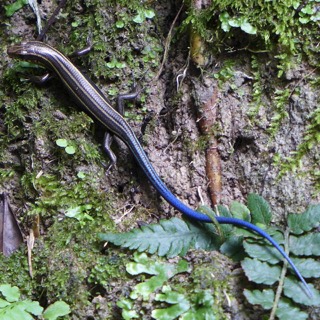 Japanese Five-lined Skink (reference photo)

Species Data
- Classification
- Squamata / Scincidae Source
- Size
- Total length 16–25 cm
- Diet
- Insectivore Carnivorous, eating insects, earthworms, and spiders, and occasionally fruit
- Distribution
- Endemic to Japan, ranging from western Honshu to Kyushu and the Osumi Islands; it was long treated as the same species as the eastern Japanese five-lined skink until molecular analysis distinguished them. Source
- Sources
- ja.wikipedia.org
Did You Know?
- Juveniles have a black body with five light stripes and a bright blue tail; as they mature the stripes fade, and breeding males develop reddish coloring on the head and belly. Source
- When threatened it can autotomize (self-detach) its tail, which continues to twitch and distract predators while the skink escapes. Source
Where to See This Species
Operating facilities registered on this site: Japan 1
Kiryuugaoka DoubutsuenGunmaIf driving, set your car navigation to "Kiryugaoka Amusement Park" (Kiryugaoka Yuenchi) rather than "Kiryugaoka Zoo" to reach the parking lot (searching by the zoo name may give an incorrect route).
Conservation Story
Conservation Status
Least Concern (LC)
Sources
Support Conservation
A visit is a small, positive way to support the daily lives of the animals you care about.
- Visit
- A visit itself helps support the facility.
- Animal Supporter Programs & Giving
- Find ways to support the facility through its official website.
- Furusato Nozei
- Municipally run facilities may share official guidance for this Japanese hometown-tax program.
FAQ
- How can you tell a young Japanese five-lined skink apart from an adult?
- Juveniles have five bright stripes on a black body and a vivid blue tail, while adults lose most of the striping and breeding males take on a reddish head and belly. Source
- Can it really drop its tail?
- Yes—when grabbed by a predator it can autotomize its tail, which keeps twitching to distract the attacker while the skink flees; the tail later regrows. Source
- How many operating facilities are registered here?
- Operating facilities registered on this site: Japan 1 Source
Books & gear
Source: ja.wikipedia.org en.wikipedia.org