Japanese Pond Turtleニホンイシガメ
Mauremys japonicaNT— Near Threatened
The Japanese pond turtle is endemic to Japan, found on Honshu, Shikoku, Kyushu, and several surrounding islands. It is omnivorous, eating fish, frogs, insects, crustaceans, and plant matter, and its coin-shaped juveniles—called "zenigame"—have long been popular pets. Habitat loss and competition from introduced species have led the IUCN to assess it as Near Threatened.
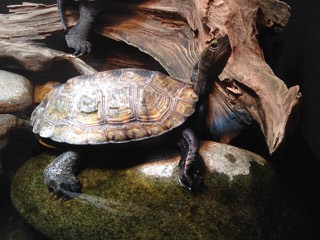 Japanese Pond Turtle (reference photo)

Species Data
- Classification
- Testudines / Geoemydidae Source
- Size
- Carapace length up to about 21 cm; females are larger than males
- Diet
- Omnivore Omnivorous, eating fish, frogs and their eggs and tadpoles, insects, shrimp, crabs, mollusks, and earthworms, as well as carrion and plants
- Distribution
- Endemic to Japan, found on Honshu (south of Akita and Miyagi prefectures), Shikoku, Kyushu, and surrounding islands including Oki, Goto, Tsushima, and Tanegashima. Source
- Sources
- ja.wikipedia.org
Did You Know?
- Juveniles are called "zenigame" (coin turtle) in Japanese because their round shell resembles a coin, and they have long been sold as pets. Source
- Molecular studies suggest it may be more closely related to the Chinese pond turtle (a different genus, Mauremys reevesii) than to other species within its own genus Mauremys. Source
Where to See This Species
Operating facilities registered on this site: Japan 6
Gokatsuraike Animal ParkMieAbout 10 minutes from the Seiwa-Taki Interchange.
Kamogawa Sea WorldChibaAbout 2 hours from Tokyo Station on the Wakashio limited express to JR Awa-Kamogawa Station, then about 10 minutes by free shuttle bus (departing from the West Exit bus stop).
Kyoto City ZooKyotoOpened in 1903
Kiryuugaoka DoubutsuenGunmaIf driving, set your car navigation to "Kiryugaoka Amusement Park" (Kiryugaoka Yuenchi) rather than "Kiryugaoka Zoo" to reach the parking lot (searching by the zoo name may give an incorrect route).
Higashiyama Zoo and Botanical GardensAichiOpened in 1937
Conservation Story
Conservation Status
Near Threatened (NT)
Sources
Support Conservation
A visit is a small, positive way to support the daily lives of the animals you care about.
- Visit
- A visit itself helps support the facility.
- Animal Supporter Programs & Giving
- Find ways to support the facility through its official website.
- Furusato Nozei
- Municipally run facilities may share official guidance for this Japanese hometown-tax program.
FAQ
- Why are baby Japanese pond turtles called 'zenigame'?
- The name means "coin turtle" in Japanese, referring to how the rounded shell of a hatchling resembles an old coin. Source
- Is the Japanese pond turtle endangered?
- It is assessed as Near Threatened by the IUCN, with habitat loss and competition from introduced turtle species contributing to its decline. Source
- How many operating facilities are registered here?
- Operating facilities registered on this site: Japan 6 Source
Books & gear
Source: ja.wikipedia.org en.wikipedia.org