Japanese Sawsharkノコギリザメ
Pristiophorus japonicusLC— Least Concern
The Japanese sawshark (Pristiophorus japonicus) is a small, nocturnal shark identified by its long, tooth-edged, saw-like snout, which it uses to injure or slice prey such as small fish, squid, and crustaceans on the seafloor. It lives on sandy or muddy bottoms of the northwestern Pacific around Japan, Korea, Taiwan, and China, from about 40 m down to 800 m deep, and is classified as Least Concern by the IUCN despite bycatch pressure from bottom trawling.
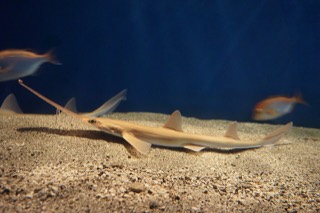 Japanese Sawshark (reference photo)

Species Data
- Classification
- Pristiophoriformes / Pristiophoridae Source
- Size
- Total length around 1.4–1.5 m (some sources give a maximum of 136–170 cm)
- Diet
- Carnivore Small fish, squid, and crustaceans such as shrimp and crabs; uses its snout to dig prey out of the sand
- Activity
- Nocturnal
- Distribution
- Found in the northwestern Pacific around Japan, Korea, Taiwan, and northern China, inhabiting sandy or muddy continental shelf bottoms at depths from around 40 m down to 800 m. Source
- Sources
- ja.wikipedia.org en.wikipedia.org
Did You Know?
- It swings its saw-like, tooth-lined snout to injure or slice prey in two, and uses a pair of fleshy barbels on the snout to sense buried animals. Source
- It poses essentially no threat to humans due to its deep, benthic habitat, but faces significant bycatch risk from bottom trawls and gillnets. Source
- The Okinawa Churaumi Aquarium achieved the world's first successful captive breeding of the Japanese sawshark in 2014. Source
Where to See This Species
Operating facilities registered on this site: Japan 4
Okinawa Churaumi AquariumOkinawaOpened in 2002
ENOSHIMA AQUARIUMKanagawaOpened in 2004
Port of Nagoya Public AquariumAichi5 minutes on foot from Exit 3 of Nagoyako Station on the Subway Meiko Line (transfer to the Meiko Line at Sakae Station on the Higashiyama Line, or at Kanayama Station on the Meitetsu and JR lines).
Aqua World Ibaraki Prefecture Oarai AquariumIbarakiAddress: 8252-3 Isohama-cho, Oarai-machi, Higashiibaraki-gun, Ibaraki Prefecture.
Conservation Story
Conservation Status
Least Concern (LC)
Sources
Support Conservation
A visit is a small, positive way to support the daily lives of the animals you care about.
- Visit
- A visit itself helps support the facility.
- Animal Supporter Programs & Giving
- Find ways to support the facility through its official website.
- Furusato Nozei
- Municipally run facilities may share official guidance for this Japanese hometown-tax program.
FAQ
- What is the Japanese sawshark's snout used for?
- It uses the long, saw-like, tooth-edged snout, aided by a pair of sensory barbels, to detect and slash or injure prey hidden in the sandy seafloor. Source
- Is the Japanese sawshark dangerous to people?
- No, its deep-water, bottom-dwelling lifestyle means it poses essentially no threat to humans. Source
- Where can the Japanese sawshark be seen in aquariums?
- Several Japanese aquariums display it, including Okinawa Churaumi Aquarium, which achieved the world's first captive breeding of the species in 2014. Source
- How many operating facilities are registered here?
- Operating facilities registered on this site: Japan 4 Source
Books & gear
Source: ja.wikipedia.org en.wikipedia.org