Japanese Sea Nettleアカクラゲ
Chrysaora pacificaNE— Not Evaluated
The Japanese sea nettle is a strikingly striped jellyfish found along the coasts of Japan and Taiwan, appearing from spring to summer. Its sting is powerful enough to be genuinely painful, and even its dried, airborne nematocysts can trigger sneezing in people nearby.
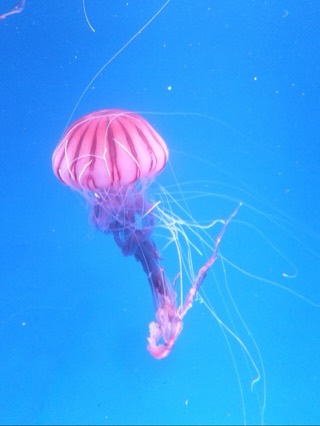 Japanese Sea Nettle (reference photo)

Species Data
- Classification
- Semaeostomeae / Pelagiidae Source
- Size
- Bell diameter about 9–21 cm (sources vary)
- Diet
- Carnivore Carnivorous, feeding mainly on zooplankton and, as it grows, also preying on small fish, krill, and other jellyfish
- Distribution
- Found in the northwest Pacific from northeastern Taiwan to Mutsu Bay in Aomori, Japan, typically appearing from spring to summer. Source
Did You Know?
- When dried, its venomous nematocysts can become airborne and trigger sneezing if inhaled, earning it the Japanese nickname "sneezing jellyfish." Source
- According to legend, the warlord Sanada Nobushige used powdered specimens of this jellyfish as a weapon, giving it the alternate nickname "Sanada jellyfish." Source
- When injured, it can restore its symmetry through a process called "symmetrization," reorganizing its remaining body parts rather than regenerating the lost tissue. Source
Where to See This Species
Operating facilities registered on this site: Japan 4
Sumida AquariumTokyoRight by Tokyo Skytree Station on the Tobu Skytree Line.
NOTOJIMA AQUARIUMIshikawaThe nearest station is Wakura-Onsen Station.
Osaka Aquarium KaiyukanOsakaOpened in 1990
Toba AquariumMieOpened in 1955
Conservation Story
Conservation Status
Not Evaluated (NE)
Sources
Support Conservation
A visit is a small, positive way to support the daily lives of the animals you care about.
- Visit
- A visit itself helps support the facility.
- Animal Supporter Programs & Giving
- Find ways to support the facility through its official website.
- Furusato Nozei
- Municipally run facilities may share official guidance for this Japanese hometown-tax program.
FAQ
- Why is the Japanese sea nettle called the "sneezing jellyfish"?
- When its body dries out, venomous nematocysts can become airborne, and inhaling them causes sneezing, which is how it earned the nickname in Japanese. Source
- What does the Japanese sea nettle eat?
- It feeds mainly on zooplankton when young, and as it grows it also preys on small fish, krill, and other jellyfish. Source
- When can you see Japanese sea nettles in the wild?
- They typically appear along Japanese coastlines from spring through summer. Source
- How many operating facilities are registered here?
- Operating facilities registered on this site: Japan 4 Source
Books & gear
Source: ja.wikipedia.org en.wikipedia.org