Japanese Rat Snakeアオダイショウ
Elaphe climacophoraLC— Least Concern
The Japanese rat snake is a large, non-venomous colubrid endemic to Japan, ranging across the archipelago except the far southwest. Semi-arboreal and mostly diurnal, it preys on rodents, frogs, lizards, and birds, using keeled belly scales to climb tree trunks in pursuit of nests and eggs. A striking albino population near Iwakuni has been protected as a national monument since 1924, and the species remains one of the most familiar snakes across rural and suburban Japan.
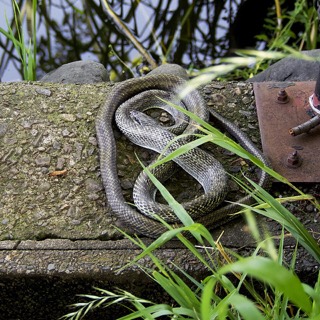 Japanese Rat Snake (reference photo)

Species Data
- Classification
- Squamata / Colubridae Source
- Size
- Total length 100–200 cm, body diameter about 5 cm
- Lifespan
- One captive individual lived 17 years 7 months
- Diet
- Carnivore Carnivorous, preying on a wide range of small animals including small mammals, frogs, lizards, and birds and their eggs and chicks
- Activity
- Diurnal
- Distribution
- Endemic to Japan, found throughout the archipelago except the far southwest (Nansei Islands), including the Izu, Oki, and Tsushima islands, as well as Russia's Kunashir Island. Source
- Sources
- ja.wikipedia.org en.wikipedia.org
Did You Know?
- Strong keeled ridges along the edges of its belly scales let it hook onto tree bark, allowing this snake to climb straight up vertical trunks. Source
- A population of albino individuals near Iwakuni in Yamaguchi Prefecture has been protected as a national monument, the "White Snakes of Iwakuni," since 1924. Source
- Japanese rat snakes mate in May and June, then lay clutches of roughly 4 to 17 eggs, each about 7 cm long, in July and August. Source
Where to See This Species
Operating facilities registered on this site: Japan 2
Higashiyama Zoo and Botanical GardensAichiOpened in 1937
Former facilities
North Safari SapporoHokkaidoOpened in 2005
Closed: 2025-09-30 Official Site
Source links to official sites, official YouTube channels, and news aggregators such as Zoo Ring. Visit the publisher for the full item.
Conservation Story
Conservation Status
Least Concern (LC)
Sources
Support Conservation
A visit is a small, positive way to support the daily lives of the animals you care about.
- Visit
- A visit itself helps support the facility.
- Animal Supporter Programs & Giving
- Find ways to support the facility through its official website.
- Furusato Nozei
- Municipally run facilities may share official guidance for this Japanese hometown-tax program.
FAQ
- Is the Japanese rat snake venomous?
- No. It is a non-venomous colubrid that kills prey by constriction or simply overpowering and swallowing it whole. Source
- How does it climb trees so well?
- Keeled ridges along both edges of its belly scales act like hooks, letting it grip bark and climb straight up vertical tree trunks in search of bird nests and eggs. Source
- Why is there a white version of this snake in Japan?
- A naturally occurring albino population near Iwakuni, Yamaguchi Prefecture, has been protected by law since 1924 as a national monument known as the "White Snakes of Iwakuni." Source
- How many operating facilities are registered here?
- Operating facilities registered on this site: Japan 2 Source
Books & gear
Source: ja.wikipedia.org en.wikipedia.org