Laughing Kookaburraワライカワセミ

Dacelo novaeguineaeLC— Least Concern

The laughing kookaburra is a large terrestrial kingfisher native to eastern Australia, instantly recognizable by its raucous, laughter-like call used to declare territory. Despite belonging to the kingfisher family, it hunts mainly on land, taking insects, small reptiles, and even snakes with its heavy bill. Common and widespread, it has also been introduced to Tasmania, Western Australia, and New Zealand.

Operating facilities registered on this site: Japan 7 (Saitama Children's Zoo, ITOZU NO MORI Zoological Park, Shizuoka Municipal Nihondaira Zoo, and 4 more). These facilities are confirmed by resident animal records or the facility’s official information.
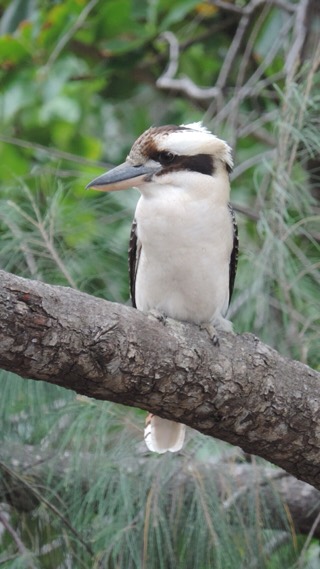
Laughing Kookaburra (reference photo)
Photo: Kerry Raymond / CC BY 4.0 / Source / cropped

Species Data

Classification
Coraciiformes / Alcedinidae Source
Size
Total length 41–47 cm (the largest kingfisher)
Weight
Males average 307 g / females 352 g
Lifespan
Lifespan around 20 years
Diet
Carnivore Preys on a wide range of small animals including insects, earthworms, snails, crayfish, small fish, lizards, frogs, nestlings, and snakes
Distribution
Native to eastern Australia from Cape York Peninsula to Cape Otway; introduced populations exist in Tasmania, Western Australia, and New Zealand. Source

Did You Know?

  • The bird takes its name from its distinctive loud call, which sounds like a person bursting into raucous laughter. Source
  • The laughing kookaburra is the largest species of kingfisher by body mass. Source
  • Its call has been used as a stock jungle sound effect in Hollywood films since the 1930s Tarzan movies. Source

Where to See This Species

Operating facilities registered on this site: Japan 7

Saitama Children's ZooSaitamaOpened in 1980

Source

ITOZU NO MORI Zoological ParkFukuokaOpened in 2002

Source

Tama ZooTokyoOpened in 1958

Source

Fukuyama City ZooHiroshimaThere is no public transportation; access is by car.

Source

Hamura ZooTokyoAbout a 20-minute walk from the East Exit of Hamura Station on the JR Ome Line.

Source

TAKAOKA KOJYO ZOOToyamaOpened in 1951

Source

Possible records, not yet confirmed: 2

These facilities are not confirmed by an official animal list. They appear in secondary sources such as Wikipedia; check the facility’s official website for current exhibits.

Tennoji ZooOsakaOpened in 1915

(Not confirmed by official sources) Source

Higashiyama Zoo and Botanical GardensAichiOpened in 1937

(Not confirmed by official sources) Source

Conservation Story

Conservation Status

Least Concern (LC)

Sources

ja.wikipedia.org

Support Conservation

A visit is a small, positive way to support the daily lives of the animals you care about.

Visit
A visit itself helps support the facility.
Animal Supporter Programs & Giving
Find ways to support the facility through its official website.
Furusato Nozei
Municipally run facilities may share official guidance for this Japanese hometown-tax program.

Individuals Remembered

No.0351In memoriam

Hikari

ひかり

Laughing KookaburraDacelo novaeguineae

Kofu City Yuki Park Zoo

Sex
Male
Born
July 20, 2017
LC— Least Concern

FAQ

Where can I see Laughing Kookaburra in Japan?
Operating facilities registered on this site: Japan 7 (Saitama Children's Zoo, ITOZU NO MORI Zoological Park, Shizuoka Municipal Nihondaira Zoo, and 4 more). These facilities are confirmed by resident animal records or the facility’s official information. Source
Why is it called the laughing kookaburra?
Its call sounds like raucous human laughter, which gives the species its common name. Source
What does the laughing kookaburra eat?
It hunts a wide variety of small animals, including insects, earthworms, snails, small fish, lizards, frogs, small birds, and snakes. Source
Is the laughing kookaburra really the largest kingfisher?
Yes, by body mass it is the largest species of kingfisher in the world. Source

Books & gear

Source: ja.wikipedia.org en.wikipedia.org