Nubian Giraffeヌビアキリン

Giraffa camelopardalis camelopardalisCR— Critically Endangered

The Nubian giraffe is the nominate subspecies of the northern giraffe, now surviving in scattered parts of Ethiopia, South Sudan, Uganda and Kenya. It has sharply defined chestnut patches bordered by pale lines and unspotted underparts, and males have a well-developed median lump on the forehead. After its numbers fell by about 95% in three decades, the IUCN placed it in the Critically Endangered category in 2018.

Operating facilities registered on this site: Japan 0 · Overseas 1. No facility is currently confirmed by resident animal records or official facility information.
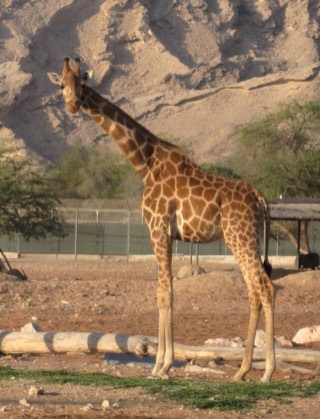
Nubian Giraffe (reference photo)
Photo: Doug Belshaw / CC BY 2.0 / Source / cropped

Species Data

Classification
Artiodactyla / Giraffidae Source
Size
Height to the tips of the ossicones 4.7–5.3 m in males and 3.9–4.5 m in females (range recorded for the genus Giraffa)
Weight
Males 800–1,930 kg, females 550–1,180 kg (range recorded for the genus Giraffa)
Lifespan
About 25 years (record for the genus as a whole)
Diet
Herbivore Herbivorous, browsing mainly on the leaves, young shoots and twigs of acacias and other trees (diet of the genus as a whole)
Activity
Feeds mainly at dawn and dusk and ruminates during the day (behaviour of the genus as a whole)
Distribution
Its remaining range covers the east of South Sudan and the southwest of Ethiopia, plus scattered pockets in Uganda and Kenya. Wild giraffes of this subspecies no longer survive in the Democratic Republic of the Congo, Egypt or Eritrea. Source

Did You Know?

  • Its extremely long forelegs give it a huge stride, so even its rather slow gallop reaches about 48 km/h. Source
  • The three giraffes that Muhammad Ali of Egypt gave to European rulers in 1827 were Nubian giraffes; the best known of them is Zarafa. Source
  • A 2016 estimate put the wild population at about 2,150, some 1,500 of them of the Rothschild's ecotype. Source

Where to See This Species

Operating facilities registered on this site: Japan 0 · Overseas 1

Cheyenne Mountain ZooOpened in 1926

No.0867In residence

Ohe

Ohe

Nubian GiraffeGiraffa camelopardalis camelopardalis

Sex
Male
Born
July 22, 2018
CR— Critically Endangered

Conservation Story

Conservation Status

Critically Endangered (CR)

Sources

en.wikipedia.org en.wikipedia.org ja.wikipedia.org

Support Conservation

A visit is a small, positive way to support the daily lives of the animals you care about.

Visit
A visit itself helps support the facility.
Animal Supporter Programs & Giving
Find ways to support the facility through its official website.

FAQ

Where can I see Nubian Giraffe in Japan?
Operating facilities registered on this site: Japan 0 · Overseas 1. No facility is currently confirmed by resident animal records or official facility information. Source
Where do Nubian giraffes live?
Its remaining range covers the east of South Sudan and the southwest of Ethiopia, plus scattered pockets in Uganda and Kenya. It has vanished from the wild in the DR Congo, Egypt and Eritrea. Source
Is the Nubian giraffe the same as the Rothschild's giraffe?
A 2016 study suggested that Rothschild's giraffe could be regarded as a form (ecotype) of the Nubian giraffe, but this has not been settled. Source
Why is the Nubian giraffe critically endangered?
Its numbers fell by about 95% over three decades, and the IUCN listed it as Critically Endangered for the first time in 2018. Source

Books & gear

Source: ja.wikipedia.org en.wikipedia.org