Panther Chameleonパンサーカメレオン
Furcifer pardalisLC— Least Concern
The panther chameleon is a large, strikingly colorful chameleon endemic to eastern and northern Madagascar. Males display dramatic color variation depending on their locality of origin—from vivid blue on Nosy Be to fiery red and green near Ambilobe—while females remain a more uniform brownish hue. Solitary and territorial outside of mating, it is one of the most popular chameleons in the pet trade due to its color diversity and relative ease of captive breeding.
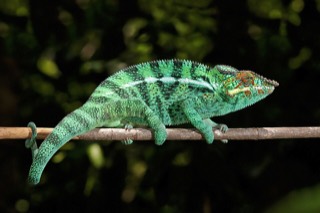 Panther Chameleon (reference photo)
_male_Nosy_Be.jpg)
Species Data
- Classification
- Squamata / Chamaeleonidae Source
- Size
- Males up to about 52 cm in total length; females are smaller, reaching at most about 30 cm
- Lifespan
- In captivity, females live about 3 years and males 5–7 years with proper care; few wild individuals survive beyond a year
- Diet
- Insectivore Carnivorous, preying mainly on arthropods such as insects and spiders, and occasionally taking plant matter
- Activity
- Diurnal and strongly solitary, living almost entirely alone outside the breeding season
- Distribution
- Native to eastern and northern Madagascar, and introduced to Réunion, Mauritius, and Florida. Source
- Sources
- ja.wikipedia.org en.wikipedia.org
Did You Know?
- Males vary dramatically in coloration by locality—vivid blue in Nosy Be, red, green, or orange around Ambilobe and Antsiranana—and these regional color forms are marketed as distinct "locales" in the pet trade. Source
- Females tend to stay a muted brownish color regardless of locality, showing far less regional color variation than males. Source
- Females lay clutches of 10 to 46 eggs in the soil, which take roughly 240 days to hatch. Source
Where to See This Species
Operating facilities registered on this site: Japan 2
Noichi Zoological Park of Kochi PrefectureKochiA 20-minute walk or 13-minute rental-bicycle ride from Noichi Station on the Tosa Kuroshio Railway Gomen-Nahari Line.
Sapporoshimaruyama DoubutsuenHokkaidoOpened in 1951
Former facilities
North Safari SapporoHokkaidoOpened in 2005
Closed: 2025-09-30 Official Site
Source links to official sites, official YouTube channels, and news aggregators such as Zoo Ring. Visit the publisher for the full item.
Conservation Story
Conservation Status
Least Concern (LC)
Sources
Support Conservation
A visit is a small, positive way to support the daily lives of the animals you care about.
- Visit
- A visit itself helps support the facility.
- Animal Supporter Programs & Giving
- Find ways to support the facility through its official website.
- Furusato Nozei
- Municipally run facilities may share official guidance for this Japanese hometown-tax program.
FAQ
- Why do panther chameleons look so different depending on where they're from?
- Males show striking regional color variation—for example, vivid blue individuals from Nosy Be versus red, green, or orange individuals near Ambilobe—and these locality-based color forms are recognized and traded as distinct "locales." Source
- Do male and female panther chameleons look different?
- Yes. Males are larger and far more colorful, with dramatic locality-based patterns, while females are smaller and tend to stay a fairly uniform brownish color regardless of where they come from. Source
- How long do panther chameleons live?
- Lifespans are short: in the wild few survive beyond a year, and in captivity females typically live around 3 years while males can reach 5 to 7 years with good care. Source
- How many operating facilities are registered here?
- Operating facilities registered on this site: Japan 2 Source
Books & gear
Source: ja.wikipedia.org en.wikipedia.org