Radiated Tortoiseホウシャガメ
Astrochelys radiataCR— Critically Endangered
The radiated tortoise is a strikingly patterned tortoise endemic to the dry spiny forests of southern Madagascar, named for the star-like yellow rays radiating across each shell scute. Almost entirely herbivorous, it is among the longest-lived reptiles on record, with one documented individual, Tu'i Malila, reaching an estimated 188 years. The species is Critically Endangered due to habitat destruction from slash-and-burn agriculture and heavy poaching for food and the illegal pet trade.
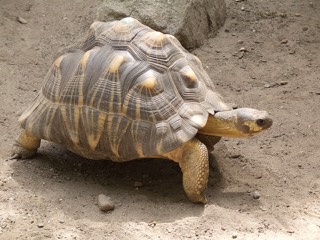 Radiated Tortoise (reference photo)

Species Data
- Classification
- Testudines / Testudinidae Source
- Size
- Carapace length 26–38 cm, with some individuals reaching 40 cm
- Weight
- 2.5–8.8 kg
- Lifespan
- Extremely long-lived; the best-documented case is an individual named "Tu'i Malila" that lived to an estimated 188 years
- Diet
- Herbivore Almost entirely herbivorous, feeding mainly on grasses along with leaves, flowers, fruit, succulents such as the introduced Opuntia (prickly pear), and mushrooms
- Activity
- Diurnal, but becomes more crepuscular in hot, dry conditions
- Distribution
- Endemic to the dry spiny thickets and brushland of extreme southern and southwestern Madagascar, with introduced populations on Réunion and Mauritius. Source
- Sources
- ja.wikipedia.org en.wikipedia.org
Did You Know?
- The genus name Astrochelys means "star tortoise" and the species name radiata means "radiating," both referring to the striking yellow star-burst pattern on each shell scute. Source
- Tu'i Malila, the most reliably documented long-lived radiated tortoise, died at an estimated age of 188, making it one of the longest-lived reptiles ever recorded. Source
- In Japan, Nogeyama Zoo in Yokohama achieved the country's first successful captive breeding of the species in 2009. Source
Where to See This Species
Operating facilities registered on this site: Japan 8
Saitama SuizokukanSaitamaAbout 15 minutes (about 7 km) by taxi from Hanyu Station or Kazo Station on the Tobu Isesaki Line.
Yokohama Shiritsu Nogeyama DoubutsuenKanagawaOpened in 1951
Kyoto City ZooKyotoOpened in 1903
Saitamakenkodomodoubutsu Shizen KouenSaitamaOpened in 1980
Hirakawa ZooKagoshimaAbout a 20-minute walk from Goino Station on the JR Ibusuki-Makurazaki Line, or take a bus bound for Taniyama / Dobutsuen from Fukuhira Nokyo-mae to the last stop.
Naganoshichausuyama DoubutsuenNaganoThe nearest station is JR Shinonoi Station.
Tennoji ZooOsakaOpened in 1915
Conservation Story
Conservation Status
Critically Endangered (CR)
Sources
Support Conservation
A visit is a small, positive way to support the daily lives of the animals you care about.
- Visit
- A visit itself helps support the facility.
- Animal Supporter Programs & Giving
- Find ways to support the facility through its official website.
- Furusato Nozei
- Municipally run facilities may share official guidance for this Japanese hometown-tax program.
FAQ
- Why is it called the radiated tortoise?
- Its name comes from the bright yellow lines that radiate outward like a star burst from the center of each dark shell scute. Source
- How long can radiated tortoises live?
- They are among the longest-lived reptiles known; the most reliably documented individual, Tu'i Malila, is estimated to have lived to about 188 years old. Source
- Why is the radiated tortoise critically endangered?
- Its native range in southern Madagascar has been heavily degraded by slash-and-burn agriculture and land conversion, compounded by intense poaching for both the bushmeat and illegal pet trades. Source
- How many operating facilities are registered here?
- Operating facilities registered on this site: Japan 8 Source
Books & gear
Source: ja.wikipedia.org en.wikipedia.org