Red-bellied Piranhaピラニア
Pygocentrus nattereriLC— Least Concern
The red-bellied piranha (Pygocentrus nattereri) is a South American characin found throughout the Amazon, Paraguay, and Paraná river basins, reaching up to 50 cm and 3.9 kg, though most individuals stay under 35 cm. Despite its fearsome reputation, it is largely an opportunistic omnivore and scavenger that eats insects, other fish, plant matter, and organic debris, and travels in shoals mainly for defense rather than coordinated hunting. It is popular in the aquarium trade and is listed as Least Concern by the IUCN.
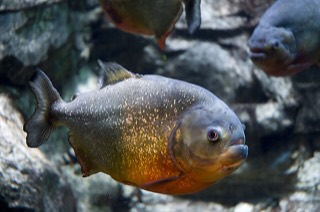 Red-bellied Piranha (reference photo)
.jpg)
Species Data
- Classification
- Characiformes / Serrasalmidae Source
- Size
- Reaches a maximum standard length of about 50 cm and weight of about 3.9 kg, but usually stays under 35 cm
- Lifespan
- About 7–10 years
- Diet
- Omnivore Omnivorous, eating a wide range of organic matter including insects, fish, aquatic plants, and carrion; during the flood season it acts largely as a scavenger, feeding mainly on plants and insects
- Distribution
- Found across South America in the Amazon, Paraguay, Paraná, and Essequibo river basins, as well as coastal rivers of northeastern Brazil. Source
- Sources
- ja.wikipedia.org en.wikipedia.org
Did You Know?
- The name "piranha" comes from the Tupi language for "tooth fish," and its razor-sharp teeth were historically used as cutting tools, including for haircuts. Source
- Juveniles are silvery with dark spots, developing the characteristic bright red belly as they mature. Source
- The famous Theodore Roosevelt story of a piranha shoal devouring a cow in moments was later found to have been staged by local guides using fish that had been starved for over a week. Source
Where to See This Species
Operating facilities registered on this site: Japan 4
Aqua World Ibaraki Prefecture Oarai AquariumIbarakiAddress: 8252-3 Isohama-cho, Oarai-machi, Higashiibaraki-gun, Ibaraki Prefecture.
Sunshine AquariumTokyoFrom Ikebukuro Station (Exit 35), walk along Sunshine 60 Street.
Osaka Aquarium KaiyukanOsakaOpened in 1990
Toba AquariumMieOpened in 1955
Former facilities
North Safari SapporoHokkaidoOpened in 2005
Closed: 2025-09-30 Official Site
Source links to official sites, official YouTube channels, and news aggregators such as Zoo Ring. Visit the publisher for the full item.
Conservation Story
Conservation Status
Least Concern (LC)
Sources
Support Conservation
A visit is a small, positive way to support the daily lives of the animals you care about.
- Visit
- A visit itself helps support the facility.
- Animal Supporter Programs & Giving
- Find ways to support the facility through its official website.
- Furusato Nozei
- Municipally run facilities may share official guidance for this Japanese hometown-tax program.
FAQ
- Is the red-bellied piranha as dangerous as its reputation suggests?
- Not really; it is mostly an opportunistic omnivore and scavenger, and the famous story of piranhas devouring a cow in seconds was staged using starved fish. Source
- What does the red-bellied piranha eat?
- It eats a broad omnivorous diet of insects, other fish, plant matter, and organic debris, feeding heavily on plants and insects when food is abundant. Source
- Why do captive piranhas sometimes lose their red color?
- Their vivid red belly is adapted to acidic, tannin-stained blackwater; without similar water conditions in captivity, the color can fade or fail to develop. Source
- How many operating facilities are registered here?
- Operating facilities registered on this site: Japan 4 Source
Books & gear
Source: ja.wikipedia.org en.wikipedia.org