Redtail Catfishレッドテールキャットフィッシュ
Phractocephalus hemioliopterusLC— Least Concern
The redtail catfish (Phractocephalus hemioliopterus), called pirarara in Brazil, is a large Amazonian catfish reaching up to about 1.8 m long, identified by its rounded head, wide mouth, six barbels, and reddish tail. An opportunistic omnivore, it eats fish, crustaceans, aquatic worms, frogs, and even fallen fruit and seeds, and is native to the Amazon, Orinoco, and Essequibo river basins. Popular but demanding in the aquarium trade, released pets have become invasive in parts of Southeast Asia and Florida.
Operating facilities registered on this site: Japan 4 (Osaka Aquarium Kaiyukan, Tochigi Nakagawa Aquatic Park, Noichi Zoological Park of Kochi Prefecture, and 1 more). These facilities are confirmed by resident animal records or the facility’s official information.
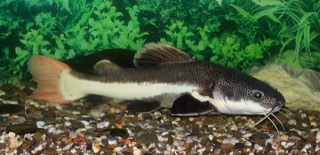 Redtail Catfish (reference photo)

Species Data
- Classification
- Siluriformes / Pimelodidae Source
- Size
- A large species with a maximum total length of about 1.8 m and a weight put at about 56–80 kg depending on the source (usually around 1.1–1.4 m in total length)
- Diet
- Omnivore Omnivorous, preying on a wide range including fish, crustaceans, aquatic worms, and amphibians such as frogs, as well as fallen fruit and seeds
- Distribution
- Native to the Amazon, Orinoco, and Essequibo river basins across Ecuador, Venezuela, Guyana, Colombia, Peru, Suriname, Bolivia, and Brazil. Source
- Sources
- ja.wikipedia.org en.wikipedia.org
Did You Know?
- It is known locally as "pirarara" in Brazil, and its reddish tail fin is the origin of its English and Japanese common names. Source
- It is known to make a clicking sound to warn off potential threats. Source
- Aquarium pets that outgrow their tanks have often been released, and the species is now established as invasive in Malaysia, Thailand, Taiwan, Hong Kong, and Florida. Source
Where to See This Species
Operating facilities registered on this site: Japan 4
Osaka Aquarium KaiyukanOsakaOpened in 1990
Tochigi Nakagawa Aquatic ParkTochigi25 km (about 45 minutes) via National Route 400 from the Nishi-Nasuno-Shiobara IC, about 40 minutes from the Yaita IC, or about 70 minutes from the Utsunomiya IC.
Noichi Zoological Park of Kochi PrefectureKochiA 20-minute walk or 13-minute rental-bicycle ride from Noichi Station on the Tosa Kuroshio Railway Gomen-Nahari Line.
Oga Aquarium GaoAkitaOpened in 2004
Possible records, not yet confirmed: 1
These facilities are not confirmed by an official animal list. They appear in secondary sources such as Wikipedia; check the facility’s official website for current exhibits.
Zoo in Kiryū, GunmaGunmaOpened in 1953
(Not confirmed by official sources) Source
Conservation Story
Conservation Status
Least Concern (LC)
Sources
Support Conservation
A visit is a small, positive way to support the daily lives of the animals you care about.
- Visit
- A visit itself helps support the facility.
- Animal Supporter Programs & Giving
- Find ways to support the facility through its official website.
- Furusato Nozei
- Municipally run facilities may share official guidance for this Japanese hometown-tax program.
FAQ
- Where can I see Redtail Catfish in Japan?
- Operating facilities registered on this site: Japan 4 (Osaka Aquarium Kaiyukan, Tochigi Nakagawa Aquatic Park, Noichi Zoological Park of Kochi Prefecture, and 1 more). These facilities are confirmed by resident animal records or the facility’s official information. Source
- How big can a redtail catfish get?
- It can reach roughly 1.8 m in length, though most captive and wild adults are smaller, around 1.1-1.4 m. Source
- What does the redtail catfish eat?
- It is an opportunistic omnivore, eating fish, crustaceans, aquatic worms, frogs, and even fallen fruit, seeds, and nuts. Source
- Why has the redtail catfish become invasive in some countries?
- Aquarium owners often release individuals that outgrow their tanks, and the species has since established invasive populations in places like Malaysia, Thailand, and Florida. Source
Books & gear
Source: ja.wikipedia.org en.wikipedia.org