Reticulated Pythonアミメニシキヘビ

Malayopython reticulatusLC— Least Concern

The reticulated python is the world's longest living snake species, native to the forests and islands of South and Southeast Asia, where its net-like camouflage pattern gives it its name. An ambush predator capable of swallowing prey nearly as heavy as itself, it kills by constriction that stops the victim's heart rather than by suffocation, as long believed. Though listed as Least Concern by the IUCN, it is heavily hunted for its skin and the exotic pet trade, and remains the only snake species with documented photographic evidence of preying on humans.

Operating facilities registered on this site: Japan 3 · Overseas 1 (iZoo, Zoo in Ōta, Gunma, Shirotori Zoo). These facilities are confirmed by resident animal records or the facility’s official information.
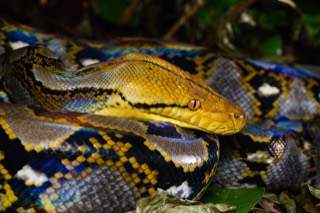
Reticulated Python (reference photo)
Photo: Rushenb / CC BY-SA 2.0 / Source / cropped

Species Data

Classification
Squamata / Pythonidae Source
Size
Total length usually 5–7 m; the record reaches 7.67 m
Weight
Usually 30–50 kg; individuals over 160 kg have been confirmed in captivity
Lifespan
Average 20–30 years
Diet
Carnivore Carnivorous, preying on mammals, birds, and reptiles; can swallow whole prey up to a quarter of its own length and roughly its own weight
Activity
Nocturnal; rests in thickets or tree hollows during the day
Distribution
Found across South and Southeast Asia, from the Nicobar Islands through Indochina, the Malay Peninsula, and the Philippine and Indonesian archipelagos; strong swimming ability has let it colonize many small islands. Source

Did You Know?

  • It holds the record as the world's longest living snake species, with a Guinness World Record specimen measured at 7.22 m and weighing 96.5 kg while unfed. Source
  • Long assumed to kill by suffocation, research from around 2015 revealed that constriction instead cuts off blood flow and stops the prey's heart, a far faster mechanism than asphyxiation. Source
  • It is the only snake species for which photographic and video evidence of consuming a human exists, with documented fatal incidents concentrated in Indonesia's Sulawesi region. Source

Where to See This Species

Operating facilities registered on this site: Japan 3 · Overseas 1

iZooShizuokaOpened in 2012

Source

Shirotori ZooKagawaBy car, about 10 minutes from the Hiketa Interchange on the Takamatsu Expressway via National Route 11 toward Takamatsu.

Source

Chester ZooOpened in 1931

No.0423In residence

Jodie Foster

Jodie Foster

Reticulated PythonMalayopython reticulatus

Sex
Female
Born
Unknown
LC— Least Concern

Conservation Story

Conservation Status

Least Concern (LC)

Sources

ja.wikipedia.org

Support Conservation

A visit is a small, positive way to support the daily lives of the animals you care about.

Visit
A visit itself helps support the facility.
Animal Supporter Programs & Giving
Find ways to support the facility through its official website.
Furusato Nozei
Municipally run facilities may share official guidance for this Japanese hometown-tax program.

FAQ

Where can I see Reticulated Python in Japan?
Operating facilities registered on this site: Japan 3 · Overseas 1 (iZoo, Zoo in Ōta, Gunma, Shirotori Zoo). These facilities are confirmed by resident animal records or the facility’s official information. Source
How big can a reticulated python get?
It is the longest snake species in the world; wild individuals commonly reach 5 to 7 meters, and the largest verified specimen measured 7.67 meters, with a Guinness-recognized individual weighing 96.5 kg while unfed. Source
How does a reticulated python actually kill its prey?
Research from around 2015 showed that constriction cuts off the prey's blood circulation and stops its heart within seconds, a much faster mechanism than the suffocation long assumed to be the cause of death. Source
Has a reticulated python ever eaten a human?
Yes—it is the only snake species for which photographic and video evidence of consuming a human exists, with several documented fatal encounters reported in Indonesia's Sulawesi region. Source

Books & gear

Source: ja.wikipedia.org en.wikipedia.org