Sloth Bearナマケグマ
Melursus ursinusVU— Vulnerable
The sloth bear is a shaggy-coated, termite-specialized bear of the Indian subcontinent, uniquely adapted with a lack of upper incisors and a mobile snout that lets it vacuum up insects from their nests. Cubs ride on their mother's back well into their second year, a striking behavior rare among bears. With fewer than 20,000 individuals estimated to remain due to habitat loss, poaching, and human-wildlife conflict, it is classified as Vulnerable by the IUCN.
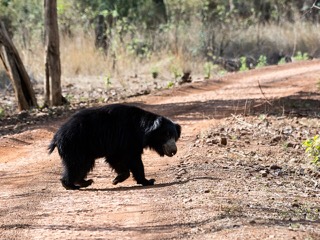 Sloth Bear (reference photo)

Species Data
- Classification
- Carnivora / Ursidae Source
- Size
- Body length 140–190 cm, shoulder height 60–92 cm, tail 10–12.5 cm
- Weight
- Males 80–145 kg (rarely up to 192 kg), females 55–105 kg (rarely 124 kg)
- Diet
- Insectivore Omnivorous, feeding mainly on termites along with other insects, bird eggs, carrion, flowers, fruit, mangoes, corn, jackfruit seeds, and honey
- Activity
- Nocturnal
- Distribution
- Native to the Indian subcontinent, inhabiting India, Nepal's Terai region, Bhutan, and Sri Lanka, in tropical forests, savannahs, and grasslands below 1,500 m elevation. Source
- Sources
- ja.wikipedia.org en.wikipedia.org
Did You Know?
- Sloth bears uniquely lack upper incisors, allowing them to purse their elongated lips and suck up large numbers of termites and ants like a vacuum after blowing away debris. Source
- Cubs stay with their mother for one and a half to three years and ride on her back as she walks, runs, or climbs trees, until they reach about a third of her size. Source
- Its coat is long, shaggy, and unkempt-looking, with a mane behind the neck that can grow up to 30 cm long. Source
Where to See This Species
Operating facilities registered on this site: Japan 2
Yokohama Shiritsu Nogeyama DoubutsuenKanagawaOpened in 1951
Sapporoshimaruyama DoubutsuenHokkaidoOpened in 1951
Conservation Story
Conservation Status
Vulnerable (VU)
Sources
Support Conservation
A visit is a small, positive way to support the daily lives of the animals you care about.
- Visit
- A visit itself helps support the facility.
- Animal Supporter Programs & Giving
- Find ways to support the facility through its official website.
- Furusato Nozei
- Municipally run facilities may share official guidance for this Japanese hometown-tax program.
FAQ
- How does the sloth bear eat termites?
- It lacks upper incisors, which lets it purse its long, mobile lips into a tube and suck up termites and ants like a vacuum after blowing debris away from the nest. Source
- Do sloth bear cubs ride on their mother's back?
- Yes, a behavior unusual among bears. Cubs cling to their mother's back as she walks, runs, or even climbs trees, until they reach roughly a third of her size, staying with her for one and a half to three years. Source
- Is the sloth bear endangered?
- The IUCN classifies it as Vulnerable, with fewer than 20,000 individuals estimated in the wild due to habitat loss, poaching for body parts, and conflict with humans. Source
- How many operating facilities are registered here?
- Operating facilities registered on this site: Japan 2 Source
Books & gear
Source: ja.wikipedia.org en.wikipedia.org