Southern Tamanduaミナミコアリクイ
Tamandua tetradactylaLC— Least Concern
The southern tamandua is a medium-sized anteater native to much of South America, from Venezuela to northern Argentina. Well adapted to life in the trees, it uses a strong prehensile tail and powerful claws to climb and forage, extending its long sticky tongue into ant and termite nests to feed. Classified as Least Concern by the IUCN, it remains widespread across forests and savannas throughout its range.
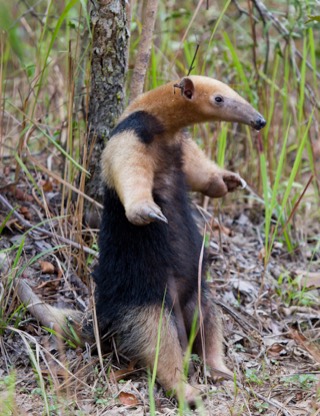 Southern Tamandua (reference photo)

Species Data
- Classification
- Pilosa / Myrmecophagidae Source
- Size
- Head-body length 34–88 cm, tail 37–67 cm
- Weight
- About 1.5–8.4 kg
- Diet
- Insectivore Feeds on ants and termites in roughly equal proportions, and sometimes raids bee nests; tends to avoid chemically defended species such as leafcutter ants
- Activity
- Mainly nocturnal, but sometimes active during the day
- Distribution
- The southern tamandua ranges from Venezuela through much of South America to northern Argentina, southern Brazil, and Uruguay, and also inhabits Trinidad. Source
- Sources
- ja.wikipedia.org en.wikipedia.org
Did You Know?
- It extends a long tongue from a narrow snout, no wider than a stick, to lap up ants and termites directly from their nest entrances. Source
- A strong prehensile tail anchors it in trees, where it may spend 13 to 64 percent of its day, but it is poorly adapted to fast ground movement and cannot gallop. Source
- Although solitary in the wild with home ranges averaging 100 to 375 hectares, southern tamanduas thrive in captivity when housed together in pairs. Source
Where to See This Species
Operating facilities registered on this site: Japan 6
Sunshine AquariumTokyoFrom Ikebukuro Station (Exit 35), walk along Sunshine 60 Street.
Izu Shaboten ZooShizuokaOpened in 1959
Noichi Zoological Park of Kochi PrefectureKochiA 20-minute walk or 13-minute rental-bicycle ride from Noichi Station on the Tosa Kuroshio Railway Gomen-Nahari Line.
Saitamakenkodomodoubutsu Shizen KouenSaitamaOpened in 1980
Higashiyama Zoo and Botanical GardensAichiOpened in 1937
Conservation Story
Conservation Status
Least Concern (LC)
Sources
Support Conservation
A visit is a small, positive way to support the daily lives of the animals you care about.
- Visit
- A visit itself helps support the facility.
- Animal Supporter Programs & Giving
- Find ways to support the facility through its official website.
- Furusato Nozei
- Municipally run facilities may share official guidance for this Japanese hometown-tax program.
FAQ
- What do southern tamanduas eat?
- They feed mainly on ants and termites in roughly equal proportions, occasionally supplementing their diet with bee larvae, and they generally avoid ant species that use strong chemical defenses. Source
- Are southern tamanduas good climbers?
- Yes, they are highly arboreal, spending a large portion of each day in trees and relying on a prehensile tail and strong claws to move and forage among branches. Source
- Where are southern tamanduas found?
- They range widely across South America, from Venezuela and the Guianas south through Brazil to northern Argentina, Uruguay, and Trinidad. Source
- How many operating facilities are registered here?
- Operating facilities registered on this site: Japan 6 Source
Books & gear
Source: ja.wikipedia.org