Spectacled Bearメガネグマ
Tremarctos ornatusVU— Vulnerable
The spectacled bear is South America's only bear species, found in the Andes Mountains from Venezuela to Bolivia and northern Argentina. Named for the pale markings often ringing its eyes, it is largely herbivorous, feeding on fruit, bromeliads, palm nuts, and bark, and is one of the few bear species that regularly climbs trees to feed and rest. The IUCN lists it as Vulnerable, mainly due to habitat loss from agriculture and mining.
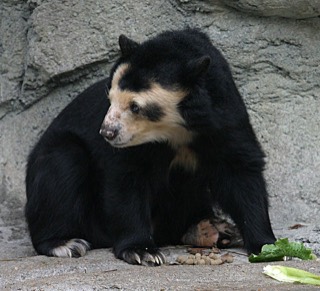 Spectacled Bear (reference photo)

Species Data
- Classification
- Carnivora / Ursidae Source
- Size
- Body length about 120–200 cm
- Weight
- Males about 130–200 kg / females about 35–65 kg
- Lifespan
- Wild: over 20 years / captive: record of 37 years 11 months
- Diet
- Omnivore Omnivore with a strong herbivorous bias, eating mainly fruit as well as bromeliad and palm leaves, bark, insects, and small mammals and reptiles; meat makes up roughly 5–7% of the diet
- Activity
- Nocturnal; rests by day beneath large trees, in tree hollows, or in nests built in the trees
- Distribution
- The spectacled bear is restricted to the Andes Mountains of Venezuela, Colombia, Ecuador, Peru, western Bolivia, and northwestern Argentina, and is the only bear species native to South America. Source
- Sources
- ja.wikipedia.org en.wikipedia.org
Did You Know?
- Distinctive cream or white markings around the eyes and throat, which can resemble spectacles, give the species both its English and Japanese common names. Source
- It mainly inhabits Andean cloud forests at elevations of 1,800 to 3,300 meters, but also uses grasslands, deserts, and dry forests across its range. Source
- One of only four arboreal bear species, its ability to climb even the tallest trees is thought to have been key to its survival alongside expanding human populations. Source
Where to See This Species
Operating facilities registered on this site: Japan 2
Yokohama Shiritsu Yokohama DoubutsuenKanagawaOpened in 1999
Higashiyama Zoo and Botanical GardensAichiOpened in 1937
Conservation Story
Conservation Status
Vulnerable (VU)
Sources
Support Conservation
A visit is a small, positive way to support the daily lives of the animals you care about.
- Visit
- A visit itself helps support the facility.
- Animal Supporter Programs & Giving
- Find ways to support the facility through its official website.
- Furusato Nozei
- Municipally run facilities may share official guidance for this Japanese hometown-tax program.
FAQ
- Why is it called the spectacled bear?
- It gets its name from the pale cream or white markings that often encircle its eyes, which can resemble a pair of glasses. Source
- What do spectacled bears eat?
- Their diet is mostly plant-based, including fruit, bromeliads, palm nuts, bamboo, and bark, with meat such as insects and small vertebrates making up only about 5 to 7 percent of intake. Source
- Are spectacled bears endangered?
- The IUCN lists them as Vulnerable, with habitat loss from agricultural expansion and illegal mining posing the main threats to wild populations. Source
- How many operating facilities are registered here?
- Operating facilities registered on this site: Japan 2 Source
Books & gear
Source: ja.wikipedia.org en.wikipedia.org