Whooper Swanオオハクチョウ
Cygnus cygnusLC— Least Concern
The whooper swan is a large, all-white swan named for its loud, bugling call, breeding across subarctic Eurosiberia and migrating south to winter in coastal Europe and East Asia, including Japan. One of the heaviest flying birds in the world, it feeds mainly on aquatic vegetation and has long been celebrated in folklore, including as Finland's national bird.
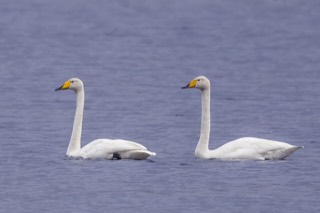 Whooper Swan (reference photo)
_pair_Oppdal.jpg)
Species Data
- Classification
- Anseriformes / Anatidae Source
- Size
- 140–165 cm; wingspan 205–275 cm
- Weight
- Males about 7.4–15 kg / females about 8.2–9.2 kg; among the heaviest of all flying birds
- Lifespan
- Said to be about 10–15 years in the wild. The longest record in captivity exceeds 25 years; in Japan, a bird confirmed 25 years 10 months after its release set the record for oldest age
- Diet
- Herbivore Feeds mainly on the leaves, stems, and roots of aquatic plants, and sometimes on invertebrates such as insects and mollusks
- Distribution
- Breeds across subarctic Eurosiberia and winters in areas such as southern Europe, the Black Sea and Caspian Sea coasts, coastal China, Korea, and Japan. Source
- Sources
- ja.wikipedia.org en.wikipedia.org
Did You Know?
- Its nest is a cone-shaped mound up to 2 meters in diameter and 50 cm high; the incubation period is about 31 days, and chicks become capable of flight 78 to 96 days after hatching. Source
- It has been Finland's national bird since 1981 and is depicted on the Finnish national design of the 1 euro coin. Source
Where to See This Species
Operating facilities registered on this site: Japan 3
Kiryuugaoka DoubutsuenGunmaIf driving, set your car navigation to "Kiryugaoka Amusement Park" (Kiryugaoka Yuenchi) rather than "Kiryugaoka Zoo" to reach the parking lot (searching by the zoo name may give an incorrect route).
Kushiroshi DoubutsuenHokkaidoAbout 55 minutes from JR Kushiro Station by Akan Bus, or about 27 minutes (18 km) by car, taxi, or rental car.
Hamamatsu Zoological GardensShizuokaOpened in 1950
Conservation Story
Conservation Status
Least Concern (LC)
Sources
Support Conservation
A visit is a small, positive way to support the daily lives of the animals you care about.
- Visit
- A visit itself helps support the facility.
- Animal Supporter Programs & Giving
- Find ways to support the facility through its official website.
- Furusato Nozei
- Municipally run facilities may share official guidance for this Japanese hometown-tax program.
FAQ
- How is the whooper swan different from the mute swan?
- The whooper swan has a straight neck held upright and a yellow-and-black bill rather than the mute swan's orange bill and curved neck, and it announces itself with a loud whooping call rather than staying largely silent. Source
- How long do whooper swans live?
- Wild birds typically live around 10 to 15 years, though captive individuals have been recorded living past 25 years, and one wild Japanese individual was confirmed alive 25 years and 10 months after being ringed. Source
- How many operating facilities are registered here?
- Operating facilities registered on this site: Japan 3 Source
Books & gear
Source: ja.wikipedia.org en.wikipedia.org