Banggai Cardinalfishバンガイカーディナルフィッシュ
Pterapogon kauderniEN— Endangered
The Banggai cardinalfish is a small, strikingly patterned reef fish endemic to Indonesia's tiny Banggai Archipelago, unusual among cardinalfish for being active by day rather than at night. Males mouthbrood their eggs for weeks without eating, but the species' extremely limited range and heavy collection for the aquarium trade have pushed it to Endangered status.
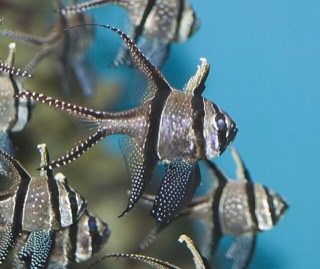 Banggai Cardinalfish (reference photo)

Species Data
- Classification
- Perciformes / Apogonidae Source
- Size
- Maximum total length 8 cm, average about 5 cm
- Lifespan
- About 1–2 years in the wild; about 4 years in captivity under good conditions
- Diet
- Planktivore Opportunistic predator feeding on plankton, mainly copepods, and on small benthic animals
- Activity
- Diurnal; known as the only cardinalfish species active during the day
- Distribution
- Endemic to Indonesia's Banggai Archipelago and adjacent waters, with an extremely limited range of roughly 5,500 square kilometers. Source
- Sources
- ja.wikipedia.org en.wikipedia.org
Did You Know?
- While most cardinalfish are nocturnal, this species is the only member of the family Apogonidae known to be diurnal, active during the day in shallow, calm reef and seagrass habitats. Source
- Males are mouthbrooders that carry fertilized eggs in their mouths for up to about 30 days without feeding; clutches are small, no more than 90 eggs, each 2 to 3 mm in diameter. Source
- Driven by aquarium trade demand, 700,000 to 900,000 fish were exported annually between 2001 and 2004, causing declines of over 90% in some populations and the extinction of at least one local population. Source
Where to See This Species
Operating facilities registered on this site: Japan 0
Verified individual animals and facilities will be added as official information becomes available.
Conservation Story
Conservation Status
Endangered (EN)
Sources
Support Conservation
A visit is a small, positive way to support the daily lives of the animals you care about.
- Visit
- A visit itself helps support the facility.
- Animal Supporter Programs & Giving
- Find ways to support the facility through its official website.
FAQ
- Why is the Banggai cardinalfish unusual for a cardinalfish?
- It is the only member of the cardinalfish family Apogonidae known to be diurnal; nearly all its relatives are nocturnal, hiding in crevices by day and feeding at night. Source
- Why is the Banggai cardinalfish endangered?
- It is endemic to a tiny area of Indonesia's Banggai Archipelago, and heavy collection for the aquarium trade—up to 900,000 fish exported per year in the early 2000s—caused population declines of over 90% in some areas. Source
- How many operating facilities are registered here?
- Operating facilities registered on this site: Japan 0 Source
Books & gear
Source: en.wikipedia.org