Blue Tangナンヨウハギ
Paracanthurus hepatusLC— Least Concern
The blue tang, also called the palette surgeonfish, is a vivid royal-blue reef fish with a yellow tail and a distinctive black "palette" marking, found across the tropical Indo-Pacific from East Africa to the Great Barrier Reef. It feeds on zooplankton and algae, defends itself with a sharp spine near its tail, and became world-famous as the character Dory in Disney/Pixar's Finding Nemo and Finding Dory.
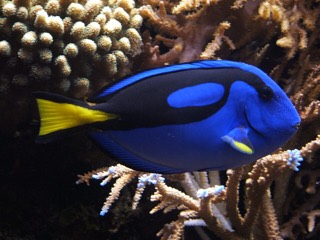 Blue Tang (reference photo)
_02.jpg)
Species Data
- Classification
- Acanthuriformes / Acanthuridae Source
- Size
- Total length about 20 cm, reaching 30 cm in large individuals
- Weight
- About 600 g as an adult
- Lifespan
- Said to be about 15 years in captivity
- Diet
- Omnivore Omnivorous; in the wild it feeds mainly on zooplankton but also grazes algae, and in captivity it eats krill and leafy vegetables
- Distribution
- Widely distributed across the tropical Indo-Pacific, from East Africa to northern Australia and Kiribati, including the Philippines, Indonesia, Japan, and the Great Barrier Reef. Source
- Sources
- ja.wikipedia.org en.wikipedia.org
Did You Know?
- It hides a sharp spine near the base of its tail and, when fighting, flicks the spine outward and slashes its body sideways at rivals. Source
- Its body color shifts with its condition, appearing vivid blue when healthy but paling to a whitish hue when sleeping or unwell; at night it wedges itself into a crevice and lies down to sleep. Source
- It ranks as the 8th most traded aquarium species worldwide, with about 95,000 individuals imported in 2011 alone; captive breeding was long considered difficult until biologist Kevin Barden achieved it for the first time in 2016 after a six-year effort. Source
Where to See This Species
Operating facilities registered on this site: Japan 3
Aquamarine FukushimaFukushimaOpened in 2000
Osaka Aquarium KaiyukanOsakaOpened in 1990
Nagasakipengin SuizokukanNagasakiOpened in 2001
Conservation Story
Conservation Status
Least Concern (LC)
Sources
Support Conservation
A visit is a small, positive way to support the daily lives of the animals you care about.
- Visit
- A visit itself helps support the facility.
- Animal Supporter Programs & Giving
- Find ways to support the facility through its official website.
- Furusato Nozei
- Municipally run facilities may share official guidance for this Japanese hometown-tax program.
FAQ
- Why is the blue tang also known as Dory?
- The species was the inspiration for the character Dory in Disney/Pixar's Finding Nemo and Finding Dory, which brought it worldwide recognition even though it was already among the most popular aquarium fish before the films. Source
- How does the blue tang defend itself?
- It has a sharp, scalpel-like spine hidden near the base of its tail, which it flicks outward and slashes sideways at rivals or threats. Source
- How many operating facilities are registered here?
- Operating facilities registered on this site: Japan 3 Source
Books & gear
Source: ja.wikipedia.org en.wikipedia.org