Bornean Orangutanボルネオオランウータン
Pongo pygmaeusCR— Critically Endangered
The Bornean orangutan is a great ape found only on the island of Borneo, spending most of its life in the forest canopy and building a fresh nest of branches and leaves nearly every night. Unlike other great apes, it lives a largely solitary life, with social bonds centered mainly on mothers and their offspring. Deforestation for logging and palm oil plantations, combined with hunting, has reduced the population to less than 14% of historical levels, and the IUCN classifies the species as Critically Endangered.
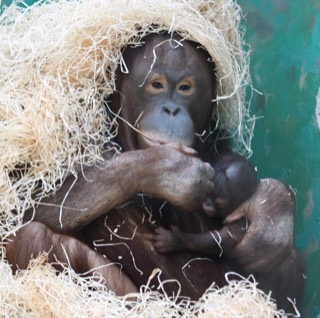 Bornean Orangutan (reference photo)

Species Data
- Classification
- Primates / Hominidae Source
- Size
- Body length about 1.0–1.7 m; males have an arm span of about 1.5–2 m
- Weight
- Males average about 75 kg (50–100 kg), females about 38.5 kg (30–50 kg)
- Lifespan
- Wild: about 35–45 years; some captive individuals have lived about 60 years
- Diet
- Omnivore Omnivorous, using more than 400 kinds of food, chiefly fruit such as figs, durians, and mangosteens, along with leaves, seeds, flowers, sap, bark, honey, fungi, bird eggs, and insects
- Activity
- Diurnal and arboreal; feeds for 2–3 hours in the morning, rests around midday, and becomes active again in late afternoon
- Distribution
- The Bornean orangutan is endemic to the island of Borneo, found in patchy, declining populations across the Malaysian states of Sabah and Sarawak and the Indonesian Kalimantan provinces. Source
- Sources
- ja.wikipedia.org en.wikipedia.org
Did You Know?
- Bornean orangutans build an elaborate new nest of branches and leaves every night. They begin practicing this skill around six months of age and master it by about age three. Source
- Unlike other great apes, Bornean orangutans are largely solitary, with social bonds centered mainly on the mother-offspring relationship — a pattern often described as 'solitary but social.' Source
- Only dominant males develop the large facial cheek pads called flanges, using long calls to attract females; the development can be suppressed in subordinate young males. Source
Where to See This Species
Operating facilities registered on this site: Japan 6
Ishikawa DoubutsuenIshikawaAbout 60 minutes from the Kanazawa-Morimoto Interchange on the Hokuriku Expressway, about 40 minutes from the Kanazawa-Nishi Interchange, and about 20 minutes from the Komatsu Interchange.
Yokohama Shiritsu Yokohama DoubutsuenKanagawaOpened in 1999
Sapporoshimaruyama DoubutsuenHokkaidoOpened in 1951
Fukuoka Zoo & Botanical GardenFukuokaOpened in 1953
Conservation Story
Conservation Status
Critically Endangered (CR)
Sources
Support Conservation
A visit is a small, positive way to support the daily lives of the animals you care about.
- Visit
- A visit itself helps support the facility.
- Animal Supporter Programs & Giving
- Find ways to support the facility through its official website.
- Furusato Nozei
- Municipally run facilities may share official guidance for this Japanese hometown-tax program.
FAQ
- Why is the Bornean orangutan critically endangered?
- Deforestation for logging and palm oil plantations has destroyed much of its habitat, and hunting adds further pressure — surveys estimated 750 to 1,800 orangutans killed annually in Kalimantan alone. The population is now less than 14% of historical levels. Source
- Do orangutans use tools?
- Yes. Bornean orangutans have been observed using leaves to wipe away feces, bundling leaves into a pad for handling spiny durian fruit, and using leafy branches to swat away bees. Source
- Are orangutans solitary animals?
- Mostly, yes. Unlike chimpanzees or gorillas, Bornean orangutans spend much of their adult lives alone, with the strongest social bonds forming between mothers and their offspring. Source
- How many operating facilities are registered here?
- Operating facilities registered on this site: Japan 6 Source
Books & gear
Source: ja.wikipedia.org en.wikipedia.org