Dromedaryヒトコブラクダ
Camelus dromedariusNE— Not Evaluated
The dromedary, or one-humped camel, is a domesticated ungulate native to North Africa and Western Asia, first tamed in the southern Arabian Peninsula around 4000–3000 BC. Remarkably adapted to arid environments, it can lose more than 30% of its body water and still recover by drinking over 100 liters at once, thanks in part to its unique oval-shaped red blood cells. As a domestic species it falls outside IUCN evaluation, though it remains a vital working and dairy animal across desert regions from North Africa to South Asia.
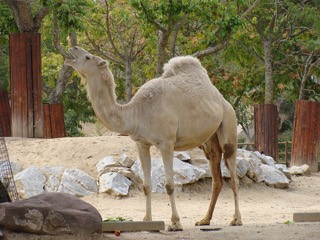 Dromedary (reference photo)

Species Data
- Classification
- Cetartiodactyla / Camelidae Source
- Size
- Body length about 350 cm, shoulder height about 180–240 cm
- Weight
- About 400–690 kg
- Lifespan
- Typically about 25 years on average in captivity, though some individuals reach 50
- Diet
- Herbivore Herbivorous, eating grasses, dry forage, thorny desert plants, and cacti; feeds 8–12 hours a day and spends a similar amount of time ruminating
- Activity
- Diurnal; moves in cohesive groups of around 20
- Distribution
- The dromedary was domesticated in the southern Arabian Peninsula around 4000–3000 BC and is now kept across Africa, the Arabian Peninsula, and the Thar Desert region of Pakistan and India, with a large feral population established in Australia. Source
- Sources
- ja.wikipedia.org en.wikipedia.org
Did You Know?
- During the breeding season, males inflate a deep-pink throat pouch called a 'dulla' from their mouths to attract females. Source
- The dromedary is the only mammal known to have oval-shaped red blood cells, an adaptation that lets it tolerate losing more than 30% of its body water and drink up to 114 liters in a single sitting without harm. Source
- The hump stores fat rather than water, holding up to 36 kg (80 lb) as an energy reserve for lean times. Source
Where to See This Species
Operating facilities registered on this site: Japan 4
Adventure WorldWakayamaOpened in 1978
Yokohama Shiritsu Yokohama DoubutsuenKanagawaOpened in 1999
Yokohama Shiritsu Nogeyama DoubutsuenKanagawaOpened in 1951
Hirakawa ZooKagoshimaAbout a 20-minute walk from Goino Station on the JR Ibusuki-Makurazaki Line, or take a bus bound for Taniyama / Dobutsuen from Fukuhira Nokyo-mae to the last stop.
Source links to official sites, official YouTube channels, and news aggregators such as Zoo Ring. Visit the publisher for the full item.
Conservation Story
Conservation Status
Not Evaluated (NE)
Sources
Support Conservation
A visit is a small, positive way to support the daily lives of the animals you care about.
- Visit
- A visit itself helps support the facility.
- Animal Supporter Programs & Giving
- Find ways to support the facility through its official website.
- Furusato Nozei
- Municipally run facilities may share official guidance for this Japanese hometown-tax program.
FAQ
- What does a dromedary's hump store?
- Fat, not water. The hump can hold up to 36 kg of fat, which the camel metabolizes for energy and water during long periods without food. Source
- How does a dromedary survive extreme dehydration?
- It can tolerate losing more than 30% of its total body water — far more than most mammals — and then rehydrate by drinking up to 114 liters in a single sitting, aided by its uniquely oval-shaped red blood cells. Source
- When were dromedaries domesticated?
- They were first domesticated in the southern Arabian Peninsula around 4000 to 3000 BC and have since become essential working and dairy animals across North Africa, the Middle East, and South Asia. Source
- How many operating facilities are registered here?
- Operating facilities registered on this site: Japan 4 Source
Books & gear
Source: ja.wikipedia.org en.wikipedia.org