Dugongジュゴン

Dugong dugonVU— Vulnerable

The dugong is a large, entirely marine mammal found across the Indo-West Pacific, from East Africa to northern Australia, and is more closely related to elephants than to whales. A specialized seagrass grazer, it uses its downturned snout to feed on the seabed and can live 50 years or more in the wild. Threatened by fishing net entanglement, habitat loss, hunting, and vessel strikes, the species has declined by roughly 20% over the past 90 years and is classified as Vulnerable by the IUCN — with an especially precarious status in Japan, where it is Critically Endangered.
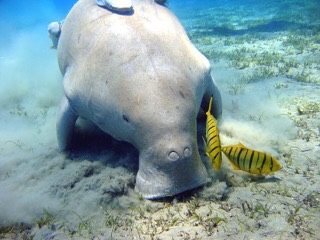
Dugong (reference photo)
Photo: Julien Willem / CC BY-SA 3.0 / Source / cropped

Species Data

Classification
Sirenia / Dugongidae Source
Distribution
The dugong ranges across the Indo-West Pacific in roughly 40 countries, from northern Mozambique and Madagascar through the Red Sea, Persian Gulf, India, and Southeast Asia to Australia, with the largest populations found in northern Australia and the Persian Gulf. Source

Did You Know?

  • The rounded shape of a female dugong's teats, which resemble breasts, is thought to have inspired mermaid legends. Source
  • During the Ryukyu Kingdom era, the island of Aragusuku in the Yaeyama Islands reportedly paid annual tribute to the kingdom in the form of dried dugong meat. Source
  • Despite living entirely in the sea, dugongs are more closely related to elephants than to whales or other marine mammals. Source

Where to See This Species

1 facilities · 1 individuals

Toba AquariumMieOpened in 1955

日本で唯一ジュゴンを飼育する水族館。雌「セレナ」が1987年から在籍し、2026年4月に入館39周年を迎えた。 Source

No.0120In residence

Serena

セレナ

DugongDugong dugon

Sex
Female
Born
Unknown
VU— Vulnerable

Latest news

2

Open the news index

Source links to official sites, official YouTube channels, and news aggregators such as Zoo Ring. Visit the publisher for the full item.

Conservation Story

Conservation Status

IUCNは危急種(VU)に分類。過去90年間で個体数は約20%減少し、香港・モーリシャス・台湾では絶滅、2022年時点で中国でも機能的に絶滅したとされる。日本では絶滅危惧IA類に指定され、確実に個体識別されている個体はわずか3頭とされる。

Habitat

海草藻場が広がる浅い沿岸海域を主な生息地とする。日本近海では沖縄諸島周辺が北限にあたる。

Threats

Conservation & Breeding Efforts

Sources

ja.wikipedia.org en.wikipedia.org

Support Conservation

A visit is a small, positive way to support the daily lives of the animals you care about.

Visit
A visit itself helps support the facility.
Animal Supporter Programs & Giving
Find ways to support the facility through its official website.
Furusato Nozei
Municipally run facilities may share official guidance for this Japanese hometown-tax program.

FAQ

What do dugongs eat?
They are seagrass specialists, feeding almost exclusively on species in the Halophila and Halodule genera, consuming roughly 10 to 16% of their body weight in seagrass each day. Source
How long do dugongs live?
Dugongs can live 50 years or more in the wild, with one individual's age estimated at 73 years based on growth rings in its tusks. Source
Are dugongs closely related to whales?
No — despite being fully aquatic, dugongs are more closely related to elephants than to whales, dolphins, or other marine mammals. Source

Source: aquarium.co.jp aquarium.co.jp www.kkday.com iseshima.keizai.biz www.iucnredlist.org