False Killer Whaleオキゴンドウ
Pseudorca crassidensNT— Near Threatened
The false killer whale is a large, highly social member of the dolphin family, found in tropical and subtropical oceans worldwide. Despite its name, it is more closely related to pilot whales than to the orca, and it hunts cooperatively for fish, squid, and even other marine mammals during the day. Known for its longevity — some captive individuals have lived past 60 years — the species is also notable for occasionally hybridizing with bottlenose dolphins. The IUCN classifies it as Near Threatened, citing bycatch and small, fragmented populations in parts of its range.
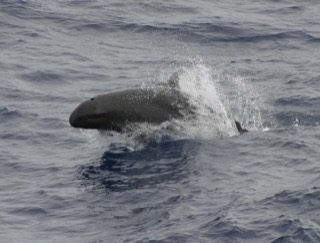 False Killer Whale (reference photo)

Species Data
- Classification
- Cetartiodactyla / Delphinidae Source
- Size
- Body length: females about 4.5–5 m, males up to about 6 m
- Weight
- Females about 1,200 kg, males about 2,200 kg
- Lifespan
- The longest records in captivity are 57 years for a male and 62 years for a female. A female named "Jumbo" kept at Shimoda Aquarium in Japan lived there for 36 years 0 months, from 1970 to 2006, then the world's longest captive record
- Diet
- Carnivore Carnivorous, hunting squid and fish of various sizes by day, and sometimes attacking other marine mammals such as dolphins; also known for causing fishery damage by stripping the flesh and organs from tuna caught on longlines
- Activity
- Mainly a diurnal hunter; dives as deep as 927.5 m and reaches top speeds of about 30 km/h
- Distribution
- The false killer whale is found worldwide in tropical and subtropical oceans, generally between 50°N and 50°S latitude. Source
- Sources
- ja.wikipedia.org en.wikipedia.org
Did You Know?
- In 1946, more than 800 false killer whales stranded at Mar del Plata, Argentina — the largest recorded stranding event for the species. Source
- False killer whales can hybridize with bottlenose dolphins to produce fertile offspring known as 'wholphins.' Source
- A female named Jumbo, kept at Shimoda Floating Aquarium in Japan from December 1970 to December 2006, lived 36 years in captivity, setting a world longevity record at the time. Source
Where to See This Species
Operating facilities registered on this site: Japan 4
Adventure WorldWakayamaOpened in 1978
Okinawa Churaumi AquariumOkinawaOpened in 2002
Shimoda AquariumShizuokaOpened in 1967
Katsurahama AquariumKochiOpened in 1931
Conservation Story
Conservation Status
Near Threatened (NT)
Sources
Support Conservation
A visit is a small, positive way to support the daily lives of the animals you care about.
- Visit
- A visit itself helps support the facility.
- Animal Supporter Programs & Giving
- Find ways to support the facility through its official website.
- Furusato Nozei
- Municipally run facilities may share official guidance for this Japanese hometown-tax program.
FAQ
- Why is it called a 'false' killer whale?
- It was named for its skull's superficial resemblance to that of the orca (killer whale), though the false killer whale is actually more closely related to pilot whales and belongs to a different genus. Source
- How long do false killer whales live?
- They are long-lived; captive records show males reaching 57 years and females 62 years. A female named Jumbo at Japan's Shimoda Floating Aquarium lived in captivity for 36 years, from 1970 to 2006. Source
- Can false killer whales interbreed with other dolphins?
- Yes, they can hybridize with bottlenose dolphins, producing fertile hybrid offspring known as 'wholphins.' Source
- How many operating facilities are registered here?
- Operating facilities registered on this site: Japan 4 Source
Books & gear
Source: ja.wikipedia.org