Fire Salamanderファイアサラマンダー
Salamandra salamandraLC— Least Concern
The fire salamander is a striking black-and-yellow amphibian native to the forests of central and southern Europe, instantly recognizable by its bold warning coloration. Rather than laying eggs like most amphibians, females give birth to already-developed larvae directly in water, and adults defend themselves by spraying a neurotoxin called samandarin from glands behind the head. Long associated with fire in European folklore—inspiring its name—the species can live for decades, with one documented individual surviving 50 years in captivity.
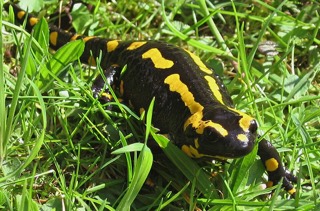 Fire Salamander (reference photo)

Species Data
- Classification
- Urodela (Caudata) / Salamandridae Source
- Size
- Total length 15–25 cm, rarely reaching 30 cm
- Weight
- About 40 g as an adult
- Lifespan
- Extremely long-lived; an individual kept at the Museum Koenig in Germany is recorded as having lived 50 years, from 1863 to 1913
- Diet
- Carnivore Terrestrial carnivore, eating earthworms, slugs, spiders, flightless insects and their larvae, and sometimes small amphibians
- Activity
- Mainly nocturnal, but also active by day in rainy weather
- Distribution
- Found across southern and central Europe, from Germany and Poland in the north to Ukraine and Romania along the Carpathians, typically at elevations of 250 to 1,000 m. Source
- Sources
- ja.wikipedia.org en.wikipedia.org
Did You Know?
- Its striking black-and-yellow warning coloration is backed up by a potent defense: when threatened, it can spray toxin from its parotoid glands at speeds of up to 300 cm per second. Source
- Its primary toxin, samandarin, causes muscle convulsions and hypertension in vertebrates; larvae lack the toxin entirely, and production only begins as the animal reaches sexual maturity. Source
- Unlike most amphibians, it is ovoviviparous, giving birth to already-developed larvae directly into water rather than laying eggs, typically producing around 30 larvae per litter and up to about 70. Source
Where to See This Species
Operating facilities registered on this site: Japan 0
Verified individual animals and facilities will be added as official information becomes available.
Conservation Story
Conservation Status
Least Concern (LC)
Sources
Support Conservation
A visit is a small, positive way to support the daily lives of the animals you care about.
- Visit
- A visit itself helps support the facility.
- Animal Supporter Programs & Giving
- Find ways to support the facility through its official website.
FAQ
- Is the fire salamander poisonous?
- Yes. It produces a neurotoxin called samandarin in glands behind its head and can actively spray it at threats, causing muscle convulsions and hypertension in vertebrates that come into contact with it. Source
- Does the fire salamander lay eggs?
- Not typically. Unlike most amphibians, females are ovoviviparous, retaining fertilized eggs internally and giving birth directly to free-swimming larvae in water, usually around 30 per litter. Source
- How long do fire salamanders live?
- They are notably long-lived amphibians; one documented individual at Museum Koenig in Germany survived for 50 years in captivity. Source
- How many operating facilities are registered here?
- Operating facilities registered on this site: Japan 0 Source
Books & gear
Source: ja.wikipedia.org en.wikipedia.org