Forest Green Tree Frogモリアオガエル
Zhangixalus arboreusLC— Least Concern
The forest green tree frog is a bright green tree frog endemic to Japan's Honshu island, best known for its unusual foam-nest breeding behavior. Females build sponge-like foam nests on branches overhanging ponds and marshes, laying hundreds of eggs inside; once hatched, tadpoles wriggle free of the foam and drop straight into the water below. Sperm competition inside the shared foam nest is thought to explain the species' unusually large testes, and the sight of foam nests hanging over countryside ponds is a familiar marker of Japan's late-spring breeding season.
Operating facilities registered on this site: Japan 1 (Tochigi Nakagawa Aquatic Park). These facilities are confirmed by resident animal records or the facility’s official information.
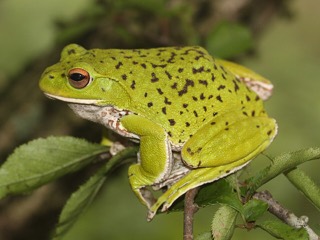 Forest Green Tree Frog (reference photo)

Species Data
- Classification
- Anura / Rhacophoridae Source
- Size
- Body length: males 42–60 mm, females 59–82 mm; females are larger
- Diet
- Insectivore Adults are carnivorous, feeding mainly on spiders and grasshoppers
- Activity
- Nocturnal; during the breeding season many individuals are active at night on tree branches about 0.5–2.0 m above the ground
- Distribution
- Endemic to Japan, primarily documented on Honshu at elevations ranging from 10 to 2,350 meters. Source
- Sources
- ja.wikipedia.org en.wikipedia.org
Did You Know?
- Females construct a sponge-like foam nest, roughly 10 to 15 cm across, on tree branches overhanging ponds and marshes, laying 300 to 800 pale yellow-white eggs inside it. Source
- Inside a single foam nest, sperm from multiple males compete intensely to fertilize the eggs, a phenomenon thought to explain why males have unusually large testes for their body size. Source
- Once hatched, tadpoles wriggle their way out of the foam nest and drop directly into the pond or marsh below to begin their aquatic life. Source
Where to See This Species
Operating facilities registered on this site: Japan 1
Tochigi Nakagawa Aquatic ParkTochigi25 km (about 45 minutes) via National Route 400 from the Nishi-Nasuno-Shiobara IC, about 40 minutes from the Yaita IC, or about 70 minutes from the Utsunomiya IC.
Possible records, not yet confirmed: 1
These facilities are not confirmed by an official animal list. They appear in secondary sources such as Wikipedia; check the facility’s official website for current exhibits.
Toyama Municipal Family Park ZooToyamaOpened in 1984
(Not confirmed by official sources) Source
Source links to official sites, official YouTube channels, and news aggregators such as Zoo Ring. Visit the publisher for the full item.
Conservation Story
Conservation Status
Least Concern (LC)
Sources
Support Conservation
A visit is a small, positive way to support the daily lives of the animals you care about.
- Visit
- A visit itself helps support the facility.
- Animal Supporter Programs & Giving
- Find ways to support the facility through its official website.
- Furusato Nozei
- Municipally run facilities may share official guidance for this Japanese hometown-tax program.
FAQ
- Where can I see Forest Green Tree Frog in Japan?
- Operating facilities registered on this site: Japan 1 (Tochigi Nakagawa Aquatic Park). These facilities are confirmed by resident animal records or the facility’s official information. Source
- Why does the forest green tree frog build foam nests?
- Females lay their eggs inside a sponge-like foam nest constructed on branches overhanging water; the foam protects the eggs from drying out and predators until the tadpoles are ready to drop into the pond below. Source
- How many eggs does a forest green tree frog lay?
- A single foam nest typically contains 300 to 800 pale yellow-white eggs. Source
- Where is the forest green tree frog found?
- It is endemic to Japan, mainly documented across Honshu at elevations from near sea level up to about 2,350 meters, with its distribution on Shikoku and Kyushu not clearly established. Source
Books & gear
Source: ja.wikipedia.org en.wikipedia.org