Golden Poison Frogモウドクフキヤガエル
Phyllobates terribilisEN— Endangered
The golden poison frog is the largest and most toxic member of the poison dart frog family, endemic to a tiny strip of Pacific rainforest in Colombia spanning less than 5,000 square kilometers. Its skin carries roughly one milligram of batrachotoxin, an amount potent enough to kill 10 to 20 humans, making it widely regarded as the most poisonous vertebrate on Earth. Indigenous Emberá hunters traditionally used its toxin to coat blowdart tips, giving the family its common English name, though the frog itself is entirely immune to its own poison thanks to evolved resistance in its muscles and nerves.
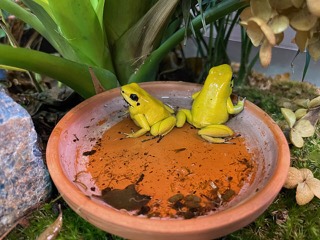 Golden Poison Frog (reference photo)
,_Entomica_3.jpg)
Species Data
- Classification
- Anura / Dendrobatidae Source
- Size
- Body length 5–6 cm; the largest species in the genus Phyllobates
- Weight
- About 30 g as an adult
- Diet
- Insectivore Carnivorous, preying mainly on ants along with other insects and small arthropods; it accumulates alkaloid toxins derived from this diet in its skin
- Activity
- Diurnal and strongly solitary; hunts by ambush
- Distribution
- Endemic to a narrow strip of Pacific rainforest in Colombia's Cauca and Valle del Cauca departments, with a total range of less than 5,000 square kilometers. Source
- Sources
- ja.wikipedia.org en.wikipedia.org
Did You Know?
- A single frog carries roughly one milligram of batrachotoxin in its skin, an amount estimated to be enough to kill 10 to 20 humans, or even two African elephants. Source
- Batrachotoxin works by locking sodium channels open, forcing muscles into sustained contraction and ultimately causing cardiac arrest, yet the frog's own muscles and nerves have evolved resistance to it. Source
- Indigenous Emberá people in Colombia traditionally coated blowdart tips with this frog's toxin for hunting, a practice reflected in the common name "poison dart frog." Source
Where to See This Species
Operating facilities registered on this site: Japan 0
Verified individual animals and facilities will be added as official information becomes available.
Conservation Story
Conservation Status
Endangered (EN)
Sources
Support Conservation
A visit is a small, positive way to support the daily lives of the animals you care about.
- Visit
- A visit itself helps support the facility.
- Animal Supporter Programs & Giving
- Find ways to support the facility through its official website.
FAQ
- How poisonous is the golden poison frog really?
- It is considered the most toxic vertebrate on Earth: a single frog carries roughly one milligram of batrachotoxin in its skin, enough to kill 10 to 20 humans or even two African elephants. Source
- Why is it called a poison dart frog?
- Indigenous Emberá people in Colombia traditionally extracted this frog's toxin and coated the tips of hunting blowdarts with it, giving rise to the common name used for the whole family. Source
- How is the frog itself immune to its own poison?
- Batrachotoxin normally forces sodium channels in muscle and nerve cells to stay open, causing fatal contractions, but this species has evolved structural resistance in those same channels, making it immune to a toxin that would kill almost any other animal. Source
- How many operating facilities are registered here?
- Operating facilities registered on this site: Japan 0 Source
Books & gear
Source: ja.wikipedia.org en.wikipedia.org