Greater Kuduグレータークーズー
Tragelaphus strepsicerosLC— Least Concern
The greater kudu (Tragelaphus strepsiceros) is a large, striped antelope of eastern and southern Africa, best known for the males' spectacular spiraled horns. It browses on leaves, grass, and shoots in rocky scrubland and woodland, feeding mainly at dawn and dusk. It is classified as Least Concern, though it is rarely kept in zoos outside Africa.
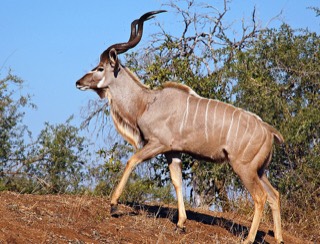 Greater Kudu (reference photo)

Species Data
- Classification
- Cetartiodactyla / Bovidae Source
- Size
- Males 190–250 cm, females 190–220 cm (height: males 130–150 cm, females 120–140 cm)
- Weight
- Males 190–315 kg, females 180–215 kg
- Lifespan
- Wild: 7–8 years / captive: up to 23 years
- Diet
- Herbivore Feeds mainly on leaves, grasses, and young shoots, and sometimes on bulbs, roots, and fruit; fond of citrus
- Activity
- Crepuscular; less active by day, feeding and drinking in early morning and evening
- Distribution
- Distributed across eastern and southern Africa from Ethiopia and eastern Sudan through Kenya and Tanzania to Angola, Zambia, Zimbabwe, and South Africa, inhabiting rocky scrubland and open woodland in hilly terrain. Source
- Sources
- ja.wikipedia.org en.wikipedia.org
Did You Know?
Where to See This Species
Operating facilities registered on this site: Japan 0
Verified individual animals and facilities will be added as official information becomes available.
Conservation Story
Conservation Status
Least Concern (LC)
Sources
Support Conservation
A visit is a small, positive way to support the daily lives of the animals you care about.
- Visit
- A visit itself helps support the facility.
- Animal Supporter Programs & Giving
- Find ways to support the facility through its official website.
FAQ
- How big are a greater kudu's horns?
- Male horns typically measure 100 to 180 cm long with about two and a half spiral twists, among the longest of any antelope. Source
- What does the greater kudu eat?
- It is a browser, feeding mainly on leaves, grass, and shoots, with an occasional taste for fruit and citrus. Source
- How many operating facilities are registered here?
- Operating facilities registered on this site: Japan 0 Source
Books & gear
Source: en.wikipedia.org