Humphead Wrasseメガネモチノウオ
Cheilinus undulatusEN— Endangered
The humphead wrasse is one of the largest reef fish in the world, a slow-growing, long-lived Indo-Pacific species named for the bulging forehead mature males develop. It hunts by day on coral reefs, preying on mollusks, crustaceans, and even toxic animals like crown-of-thorns starfish, but its popularity as a luxury seafood item has driven catastrophic population declines and Endangered status.
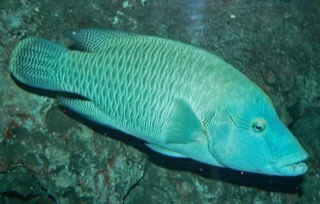 Humphead Wrasse (reference photo)

Species Data
- Classification
- Labriformes / Labridae Source
- Size
- Males can exceed 2 m, with a record total length of 229 cm; females rarely exceed 1 m
- Weight
- Record about 191 kg
- Lifespan
- Maximum recorded in the wild about 30–32 years
- Diet
- Carnivore Carnivorous, preying on small bottom-dwelling animals such as small fish, mollusks, crustaceans, and sea urchins, and also eating venomous or toxic animals such as sea hares, boxfish, and crown-of-thorns starfish
- Activity
- Diurnal
- Distribution
- Widely distributed across Indo-Pacific coral reefs, from the Red Sea and East Africa through the Indian and Pacific Oceans to the central Pacific. Source
- Sources
- ja.wikipedia.org en.wikipedia.org
Did You Know?
- Mature males develop a bulging, humped forehead and an enlarged head that can make up roughly a third of their total length, while their coloration transforms dramatically from the pale blue-and-indigo pattern of juveniles and females into a yellowish-brown to blue-green hue. Source
- It is one of the few natural predators of the coral-eating crown-of-thorns starfish, and has been observed cracking open sea urchins by carrying them to a rock and striking them against it, a tool-like feeding behavior. Source
- Highly prized in the live reef food fish trade, it has suffered catastrophic declines from overfishing—populations in Sabah, Malaysia, are estimated to have fallen by about 99%—leading to its Endangered status. Source
Where to See This Species
Operating facilities registered on this site: Japan 3
NOTOJIMA AQUARIUMIshikawaThe nearest station is Wakura-Onsen Station.
Aquamarine FukushimaFukushimaOpened in 2000
Kyoto AquariumKyotoAbout a 15-minute walk from the central exit of JR Kyoto Station.
Source links to official sites, official YouTube channels, and news aggregators such as Zoo Ring. Visit the publisher for the full item.
Conservation Story
Conservation Status
Endangered (EN)
Sources
Support Conservation
A visit is a small, positive way to support the daily lives of the animals you care about.
- Visit
- A visit itself helps support the facility.
- Animal Supporter Programs & Giving
- Find ways to support the facility through its official website.
- Furusato Nozei
- Municipally run facilities may share official guidance for this Japanese hometown-tax program.
FAQ
- Why is the humphead wrasse endangered?
- It is heavily targeted for the live reef food fish trade, where it commands very high prices; combined with its slow growth and late sexual maturity, this has caused severe population declines, with some areas like Sabah, Malaysia, seeing drops of about 99%. Source
- What makes the humphead wrasse important to coral reefs?
- It is one of the few predators willing to eat the coral-eating crown-of-thorns starfish, helping to keep outbreaks of this reef-destroying species in check. Source
- How many operating facilities are registered here?
- Operating facilities registered on this site: Japan 3 Source
Books & gear
Source: ja.wikipedia.org en.wikipedia.org