Orchid Mantisハナカマキリ
Hymenopus coronatusNE— Not Evaluated
The orchid mantis is a master of floral mimicry, its pink and white body resembling flower petals so convincingly that it attracts more pollinating insects than real flowers do. Native to the rainforests of Southeast Asia, it ambushes bees, moths, and other visiting insects, and shows striking sexual dimorphism, with females roughly twice the size of males.
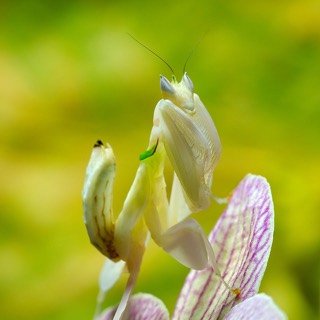 Orchid Mantis (reference photo)

Species Data
- Classification
- Mantodea / Hymenopodidae Source
- Size
- Females about 70 mm in body length, males about half that at roughly 35 mm, a pronounced sexual dimorphism
- Diet
- Insectivore Nymphs hunt mainly bees and wasps; adults ambush flower-visiting insects such as bees and butterflies
- Distribution
- Found throughout tropical Southeast Asia, including Cambodia, Indonesia, Laos, Malaysia, Myanmar, Thailand, and Vietnam. Source
- Sources
- ja.wikipedia.org en.wikipedia.org
Did You Know?
- Nymphs not only resemble flowers in shape but also release chemical compounds similar to bee pheromones, adding a chemical layer to their mimicry. Source
- Its ultraviolet reflectance pattern closely resembles real flowers, and studies have found it can attract even more pollinating insects than actual flowers do. Source
- Newly hatched nymphs resemble toxic assassin bugs, a form of mimicry that likely helps deter predators. Source
Where to See This Species
Operating facilities registered on this site: Japan 1
Adachi Park of Living ThingsTokyoAbout 20 minutes on foot from the east exit of Takenotsuka Station on the Tobu Skytree Line.
Conservation Story
Conservation Status
Not Evaluated (NE)
Sources
Support Conservation
A visit is a small, positive way to support the daily lives of the animals you care about.
- Visit
- A visit itself helps support the facility.
- Animal Supporter Programs & Giving
- Find ways to support the facility through its official website.
- Furusato Nozei
- Municipally run facilities may share official guidance for this Japanese hometown-tax program.
FAQ
- How does the orchid mantis catch its prey?
- It disguises itself as a flower, using both its petal-like limbs and pheromone-like chemical cues to lure in pollinating insects such as bees and moths, which it then ambushes. Source
- How different in size are male and female orchid mantises?
- Females are much larger, reaching about 70 mm in body length, while males grow to only about half that size. Source
- Does the orchid mantis really attract more insects than real flowers?
- Yes, research has found that its ultraviolet reflectance pattern is so flower-like that it can lure in even more pollinating insects than actual blossoms. Source
- How many operating facilities are registered here?
- Operating facilities registered on this site: Japan 1 Source
Books & gear
Source: ja.wikipedia.org en.wikipedia.org