Porcupinefishハリセンボン
Diodon holocanthusLC— Least Concern
The long-spine porcupinefish (Diodon holocanthus), known in Japan as harisenbon, is a reef fish found in tropical and subtropical waters worldwide, reaching about 40-50 cm long. When threatened, it gulps water to inflate its body, causing its normally flattened spines to stand erect and deter predators. It hunts hard-shelled prey such as mollusks, sea urchins, and crabs at night, crushing them with fused, beak-like teeth, and is listed as Least Concern by the IUCN.
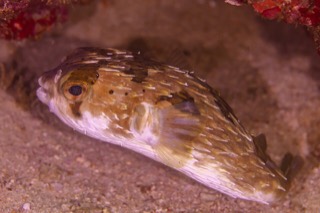 Porcupinefish (reference photo)
,_islas_Ad_Dimaniyat,_Om%C3%A1n,_2024-08-13,_DD_48.jpg)
Species Data
- Classification
- Tetraodontiformes / Diodontidae Source
- Size
- Total length about 40–50 cm
- Diet
- Carnivore Carnivorous, crushing benthic animals such as mollusks, crustaceans, sea urchins, hermit crabs, and crabs with its sturdy teeth
- Activity
- Nocturnal
- Distribution
- Circumtropical, occurring across the Atlantic, Indian, and Pacific Oceans, from Florida and the Bahamas to Brazil in the western Atlantic and across tropical regions worldwide. Source
- Sources
- ja.wikipedia.org en.wikipedia.org
Did You Know?
- When threatened, it gulps water or air to inflate its body; its normally flattened spines then stand erect, both deterring predators and making it look larger. Source
- A survey of about a thousand individuals found an average of 369 spines per fish. Source
- Spawning occurs at the surface at dawn or dusk, either in pairs or in groups of several males with a single female. Source
Where to See This Species
Operating facilities registered on this site: Japan 4
OkuhidakumabokujouGifu2535 Hitoegane, Okuhida Onsengo, Takayama, Gifu.
Osaka Aquarium KaiyukanOsakaOpened in 1990
Kyoto AquariumKyotoAbout a 15-minute walk from the central exit of JR Kyoto Station.
Nagasakipengin SuizokukanNagasakiOpened in 2001
Conservation Story
Conservation Status
Least Concern (LC)
Sources
Support Conservation
A visit is a small, positive way to support the daily lives of the animals you care about.
- Visit
- A visit itself helps support the facility.
- Animal Supporter Programs & Giving
- Find ways to support the facility through its official website.
- Furusato Nozei
- Municipally run facilities may share official guidance for this Japanese hometown-tax program.
FAQ
- How does a porcupinefish inflate itself?
- It gulps water (or air, out of water) into its stomach, which causes its body to balloon outward and its spines to stand erect. Source
- What does the porcupinefish eat?
- It preys on hard-shelled bottom-dwelling animals such as mollusks, sea urchins, hermit crabs, and crabs, crushing them with its beak-like fused teeth. Source
- How many spines does a porcupinefish have?
- A survey of roughly a thousand individuals found an average of 369 spines per fish. Source
- How many operating facilities are registered here?
- Operating facilities registered on this site: Japan 4 Source
Books & gear
Source: ja.wikipedia.org en.wikipedia.org