Red King Crabタラバガニ
Paralithodes camtschaticusNE— Not Evaluated
The red king crab is the largest king crab species, with a carapace up to 28 cm wide and a leg span reaching 1.8 m. Native to the cold waters of the North Pacific, it was introduced to the Barents Sea by the Soviet Union in the 1960s and has since become an invasive species along the Norwegian coast. Its conservation status has not been formally evaluated by the IUCN, though it remains one of the world's most valuable commercial crab fisheries.
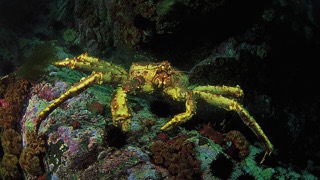 Red King Crab (reference photo)

Species Data
- Classification
- Decapoda (Anomura) / Lithodidae Source
- Size
- A large crustacean with a carapace width of about 25 cm and a leg span of over 1 m
- Weight
- Adult males harvested in the Bering Sea average about 2.9 kg
- Lifespan
- Males about 30–31 years, females about 25–34 years; sexual maturity at around 10 years
- Diet
- Carnivore Carnivorous, feeding on small benthic animals such as polychaete worms and mollusks
- Distribution
- Native to cold North Pacific waters below 10°C, from the Sea of Okhotsk and Bering Sea to the Arctic Ocean, ranging south to Sado, Japan and north to Arctic Alaska; introduced to the Barents Sea by the Soviet Union in the 1960s, where it is now an established invasive species. Source
- Sources
- ja.wikipedia.org en.wikipedia.org
Did You Know?
Where to See This Species
Operating facilities registered on this site: Japan 1
Aquamarine FukushimaFukushimaOpened in 2000
Conservation Story
Conservation Status
Not Evaluated (NE)
Sources
Support Conservation
A visit is a small, positive way to support the daily lives of the animals you care about.
- Visit
- A visit itself helps support the facility.
- Animal Supporter Programs & Giving
- Find ways to support the facility through its official website.
- Furusato Nozei
- Municipally run facilities may share official guidance for this Japanese hometown-tax program.
FAQ
- Is the red king crab a true crab?
- No—taxonomically it belongs to Anomura, the same group as hermit crabs, not the true crabs (Brachyura), as shown by the asymmetry of the female's abdomen. Source
- Why is it called 'red' king crab if it looks dark purple alive?
- Its living shell is dark purple; it only turns the familiar bright red-orange color after being cooked. Source
- How many operating facilities are registered here?
- Operating facilities registered on this site: Japan 1 Source
Books & gear
Source: ja.wikipedia.org en.wikipedia.org