Sea Angel (Clione)クリオネ
Clione limacinaNE— Not Evaluated
The sea angel, Clione limacina, is a small pelagic sea slug that drifts through cold polar and subpolar waters of the Arctic Ocean, North Pacific, North Atlantic, and Southern Ocean. Despite its delicate, wing-like appearance, it is an exclusive predator of the sea butterfly Limacina helicina, seizing prey with six tentacle-like buccal cones and pulling them from their shells. Its conservation status has not been formally evaluated by the IUCN, though ocean acidification is weakening the shells of the sea butterflies it depends on.
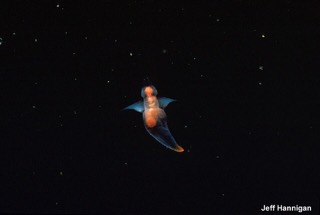 Sea Angel (Clione) (reference photo)

Species Data
- Classification
- Gymnosomata / Clionidae Source
- Size
- About 1–3 cm as an adult; the northern subspecies reaches 7–8.5 cm, the largest of the pteropods
- Lifespan
- At least 2 years (observations in Svalbard)
- Diet
- Carnivore Larvae filter feed on phytoplankton, but adults switch to a carnivorous diet consisting solely of shelled pteropods of the genus Limacina
- Distribution
- Widely distributed in cold currents around both poles, including the Arctic Ocean, North Pacific, North Atlantic, and Southern Ocean; in Japan it is found along the Sea of Okhotsk coast. Source
- Sources
- ja.wikipedia.org en.wikipedia.org
Did You Know?
- Despite its nickname "angel of the drift ice," it hunts by extending six tentacle-like buccal cones from its head to pull prey snails completely out of their shells and swallow them whole. Source
- Once it switches to a carnivorous diet, it becomes remarkably tolerant of starvation, with some individuals surviving a full year without food. Source
Where to See This Species
Operating facilities registered on this site: Japan 6
Sunshine AquariumTokyoFrom Ikebukuro Station (Exit 35), walk along Sunshine 60 Street.
Echizen Matsushima AquariumFukuiOpened in 1959
Osaka Aquarium KaiyukanOsakaOpened in 1990
WAKKANAI NOSHAPPU AQUARIUMHokkaidoOpened in 1968
Toba AquariumMieOpened in 1955
UOZU AQUARIUMToyamaOpened in 1913
Former facilities
Shima MarinelandMieOpened in 1970
Closed: 2021-03-31 Official Site
Conservation Story
Conservation Status
Not Evaluated (NE)
Sources
Support Conservation
A visit is a small, positive way to support the daily lives of the animals you care about.
- Visit
- A visit itself helps support the facility.
- Animal Supporter Programs & Giving
- Find ways to support the facility through its official website.
- Furusato Nozei
- Municipally run facilities may share official guidance for this Japanese hometown-tax program.
FAQ
- What does a sea angel eat?
- As an adult it feeds almost exclusively on Limacina helicina, a related pelagic snail, extracting the animal from its shell with tentacle-like buccal cones. Source
- How long do sea angels live?
- Studies in Svalbard suggest a life cycle of at least two years, and carnivorous adults can survive up to a year without feeding. Source
- How many operating facilities are registered here?
- Operating facilities registered on this site: Japan 6 Source
Books & gear
Source: ja.wikipedia.org en.wikipedia.org