Short-beaked Echidnaハリモグラ
Tachyglossus aculeatusLC— Least Concern
The short-beaked echidna is a spine-covered, egg-laying monotreme found throughout Australia, Tasmania, and New Guinea, making it Australia's most widespread native mammal. Equipped with an electroreceptive snout and a sticky tongue for catching ants and termites, it also has an unusually low body temperature that can drop close to 5°C during hibernation. Despite being classified as Least Concern by the IUCN, it faces local threats from vehicle strikes and habitat loss.
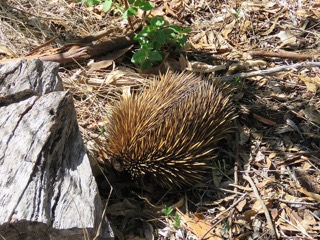 Short-beaked Echidna (reference photo)
_in_Serpentine_National_Park,_May_2021_01.jpg)
Species Data
- Classification
- Monotremata / Tachyglossidae Source
- Size
- Body length 30–45 cm, snout about 75 mm
- Weight
- 2–8 kg
- Lifespan
- Wild: average about 10 years (records of 45–49 years) / captive: one individual lived 49 years at the Philadelphia Zoo
- Diet
- Insectivore Insectivorous, feeding mainly on ants and termites; breaks open nests with its snout and forelimbs and laps up prey with its sticky tongue. A 3 kg individual was recorded eating 200 g of termites in just 10 minutes
- Activity
- Mainly crepuscular, but tends to be nocturnal in hot periods and diurnal in cold periods; may hibernate in winter
- Distribution
- Found throughout mainland Australia, Tasmania, and the coastal and highland regions of eastern New Guinea, making it Australia's most widespread native mammal. Source
- Sources
- ja.wikipedia.org en.wikipedia.org
Did You Know?
- Along with the platypus, the short-beaked echidna is one of only a handful of egg-laying mammals; it lays a single egg about 14–16 mm in diameter, which hatches after roughly 10 days. Source
- Its snout contains electroreceptors sensitive enough to detect electric fields of just 1.8 mV/cm, roughly 1,000 times more sensitive than human touch. Source
- Its resting body temperature of 30–32°C is unusually low for a mammal, and during hibernation it can drop to nearly 5°C while heart rate falls from a resting 50–68 beats per minute to just 4–7. Source
Where to See This Species
Operating facilities registered on this site: Japan 1
Source links to official sites, official YouTube channels, and news aggregators such as Zoo Ring. Visit the publisher for the full item.
Conservation Story
Conservation Status
Least Concern (LC)
Sources
Support Conservation
A visit is a small, positive way to support the daily lives of the animals you care about.
- Visit
- A visit itself helps support the facility.
- Animal Supporter Programs & Giving
- Find ways to support the facility through its official website.
- Furusato Nozei
- Municipally run facilities may share official guidance for this Japanese hometown-tax program.
FAQ
- Does the short-beaked echidna lay eggs?
- Yes. It is one of only a few living egg-laying mammals, or monotremes, along with the platypus. It lays a single small egg, about 14–16 mm across, which hatches in roughly 10 days. Source
- How does the short-beaked echidna find food?
- It uses electroreceptors in its snout, sensitive enough to detect fields as weak as 1.8 mV/cm—about 1,000 times more sensitive than human touch—to locate ants and termites, which it then catches with a sticky tongue. Source
- Do short-beaked echidnas hibernate?
- Yes, during the Australian winter. Their already low body temperature of 30–32°C can drop to nearly 5°C, and heart rate falls from a resting 50–68 beats per minute to just 4–7. Source
- How many operating facilities are registered here?
- Operating facilities registered on this site: Japan 1 Source
Books & gear
Source: ja.wikipedia.org en.wikipedia.org