Six-banded Armadilloムツオビアルマジロ
Euphractus sexcinctusLC— Least Concern
The six-banded armadillo is an omnivorous armadillo of South America's open grasslands and Cerrado savanna, named for the roughly six movable bands of armor across its back. Unlike many armadillo species, it cannot roll into a defensive ball and instead relies on running or flattening itself to the ground, while its efficient digging and ability to store fat help it survive lean periods. Classified as Least Concern by the IUCN, it remains widespread across its range.
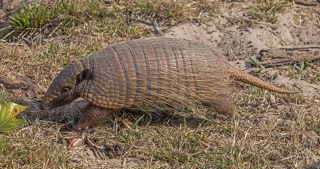 Six-banded Armadillo (reference photo)
.JPG)
Species Data
- Classification
- Cingulata / Chlamyphoridae Source
- Size
- Body length about 40–50 cm
- Weight
- 3.2–6.5 kg (may reach 8–11 kg when carrying fat reserves)
- Lifespan
- One captive individual lived about 18 years
- Diet
- Omnivore Omnivorous, eating a wide range of plant and animal matter including carrion, small invertebrates, insects, ants, fruit, palm nuts, and tubers
- Activity
- Unlike most other armadillos, it is said to be largely diurnal, though nocturnal activity has also been observed
- Distribution
- Found across South America's open grasslands and Cerrado savanna, from Brazil and southern Suriname through Bolivia, Paraguay, and Uruguay to northern Argentina. Source
- Sources
- ja.wikipedia.org en.wikipedia.org
Did You Know?
- Unlike many armadillo species, the six-banded armadillo cannot roll into a ball, so it relies on running away or flattening itself against the ground to avoid predators. Source
- It can store subcutaneous fat to sustain itself when food is scarce, allowing its body weight to increase from a typical 3.2–6.5 kg up to 8–11 kg. Source
- Named for the roughly six movable bands across its back armor, it digs efficient U-shaped burrows averaging 19 cm in height and 21 cm wide at the entrance. Source
Where to See This Species
Operating facilities registered on this site: Japan 2
Tobe Zoological Park of Ehime PrefectureEhimeOpened in 1988
Chiba Zoological ParkChibaOpened in 1985
Former facilities
North Safari SapporoHokkaidoOpened in 2005
Closed: 2025-09-30 Official Site
Source links to official sites, official YouTube channels, and news aggregators such as Zoo Ring. Visit the publisher for the full item.
Conservation Story
Conservation Status
Least Concern (LC)
Sources
Support Conservation
A visit is a small, positive way to support the daily lives of the animals you care about.
- Visit
- A visit itself helps support the facility.
- Animal Supporter Programs & Giving
- Find ways to support the facility through its official website.
- Furusato Nozei
- Municipally run facilities may share official guidance for this Japanese hometown-tax program.
FAQ
- Can the six-banded armadillo roll into a ball?
- No. Unlike many armadillo species, it cannot curl into a ball, so it defends itself by running away or pressing flat against the ground instead. Source
- What does the six-banded armadillo eat?
- It is an omnivore, eating carrion, small invertebrates, insects, ants, fruit, palm nuts, and tubers. Source
- How does the six-banded armadillo survive food shortages?
- It can store subcutaneous fat reserves, allowing its body weight to rise from a typical 3.2–6.5 kg up to 8–11 kg to sustain it through periods when food is scarce. Source
- How many operating facilities are registered here?
- Operating facilities registered on this site: Japan 2 Source
Books & gear
Source: ja.wikipedia.org