Tuataraムカシトカゲ
Sphenodon punctatusLC— Least Concern
The tuatara is a reptile endemic to New Zealand and the sole living member of the order Rhynchocephalia, a lineage otherwise known only from fossils. Though it resembles a lizard, it is only distantly related to true lizards, and hatchlings possess a light-sensing "third eye" that disappears within months of hatching. Long marketed as a "living fossil," a label paleontologists now dispute for lack of a continuous fossil record, it survives today mainly on predator-free offshore islands after vanishing from mainland New Zealand.
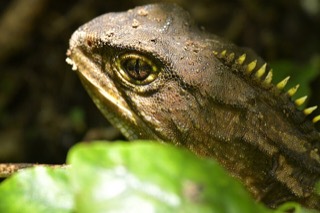 Tuatara (reference photo)

Species Data
- Classification
- Rhynchocephalia / Sphenodontidae Source
- Size
- Total length up to about 80 cm; a typical male has a snout-vent length of 280 mm and a total length of about 610 mm
- Weight
- Males up to about 1 kg, females up to about 0.5 kg
- Lifespan
- Average lifespan is put at about 60 years, but some captive individuals have lived over 100; one named "Henry" is recorded as having fathered offspring at 111
- Diet
- Carnivore Carnivorous, feeding mainly on ground-dwelling invertebrates such as beetles, crickets, spiders, and earthworms, and also preying on frogs, small reptiles, and seabird eggs and chicks
- Activity
- Adults are basically nocturnal but also bask to raise their body temperature; hatchlings are diurnal and stay hidden under cover
- Distribution
- Endemic to New Zealand, now naturally surviving on about 29 offshore islands after disappearing from the mainland; recent reintroduction programs have had some success restoring mainland populations. Source
- Sources
- ja.wikipedia.org en.wikipedia.org
Did You Know?
- Though lizard-like in appearance, the tuatara belongs to its own distinct order, Rhynchocephalia, and is the only living representative of that entire lineage. Source
- Hatchlings display a translucent "parietal eye" (a light-sensing third eye) at the top of the skull, but it becomes covered by opaque skin and disappears within four to six months. Source
- Often called a "living fossil" said to have remained largely unchanged for roughly 200 million years, though paleontologists note there is no continuous fossil record to actually support that claim. Source
Where to See This Species
Operating facilities registered on this site: Japan 0
Verified individual animals and facilities will be added as official information becomes available.
Conservation Story
Conservation Status
Least Concern (LC)
Sources
Support Conservation
A visit is a small, positive way to support the daily lives of the animals you care about.
- Visit
- A visit itself helps support the facility.
- Animal Supporter Programs & Giving
- Find ways to support the facility through its official website.
FAQ
- Is the tuatara a lizard?
- No. Despite its lizard-like appearance, it belongs to a separate order, Rhynchocephalia, of which it is the only living species; true lizards belong to a different order entirely. Source
- Does the tuatara really have a third eye?
- Hatchlings have a light-sensitive "parietal eye" visible as a translucent patch atop the skull, but it becomes covered by skin and effectively disappears within four to six months of hatching. Source
- Is it accurate to call the tuatara a "living fossil"?
- The label is popular but contested—while the tuatara's body plan resembles ancient relatives, paleontologists point out there is no unbroken fossil record demonstrating that it has remained unchanged for millions of years. Source
- How many operating facilities are registered here?
- Operating facilities registered on this site: Japan 0 Source
Books & gear
Source: ja.wikipedia.org en.wikipedia.org