Walrusセイウチ

Odobenus rosmarusVU— Vulnerable

The walrus is a large pinniped of Arctic and subarctic waters, instantly recognizable by its long tusks, thick whiskers, and massive bulk. It forages mainly for bivalve mollusks on the seafloor, using sensitive whiskers to locate prey, and gathers in huge seasonal groups on sea ice or coastal haul-outs. The IUCN lists the walrus as Vulnerable, as shrinking Arctic sea ice increasingly limits its access to resting and feeding habitat.
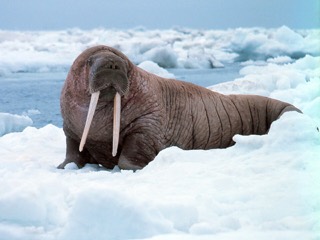
Walrus (reference photo)
Photo: Captain Budd Christman, NOAA Corps / Public domain / Source / cropped

Species Data

Classification
Carnivora / Odobenidae Source
Size
Males average about 310 cm / females average about 260 cm (Atlantic subspecies)
Weight
Males about 800–2,000 kg / females about 560–800 kg
Lifespan
Wild: about 20–30 years / captive: record of 49 years
Diet
Carnivore Feeds mainly on benthic invertebrates, especially bivalves, as well as gastropods, octopuses, and crustaceans; uses its sensitive whiskers and suction to extract prey from seafloor sediment
Distribution
The walrus inhabits Arctic and subarctic waters of the Northern Hemisphere, including the Bering, Chukchi, and Barents Seas, with distinct Atlantic and Pacific subspecies and an isolated Laptev Sea population. Source

Did You Know?

  • The tusks are elongated upper canines that grow throughout life, reaching up to a meter in males, and are used to haul out onto ice and maintain breathing holes. Source
  • It has 400 to 700 whiskers, sensitive enough to detect objects as small as 2 to 3 millimeters on the seafloor. Source
  • Its blubber layer can reach up to 15 cm thick, insulating it against the frigid waters of its Arctic habitat. Source

Where to See This Species

Operating facilities registered on this site: Japan 8

Toba AquariumMieOpened in 1955

Source

No.0121In residence

Ichiko

いちこ

WalrusOdobenus rosmarus

Sex
Female
Born
April 15, 2024
VU— Vulnerable
No.0122In residence

Tsurara

ツララ

WalrusOdobenus rosmarus

Sex
Female
Born
May 31, 2009
VU— Vulnerable

Ise Sea ParadiseMieOpened in 1966

Source

No.0124In residence

Himawari

ヒマワリ

WalrusOdobenus rosmarus

Sex
Female
Born
Unknown
VU— Vulnerable
No.0125In residence

Tanpopo

タンポポ

WalrusOdobenus rosmarus

Sex
Female
Born
Unknown
VU— Vulnerable

Otaru AquariumHokkaidoOpened in 1958

Source

Kamogawa Sea WorldChibaAbout 2 hours from Tokyo Station on the Wakashio limited express to JR Awa-Kamogawa Station, then about 10 minutes by free shuttle bus (departing from the West Exit bus stop).

Source

Yokohama Hakkeijima Sea ParadiseKanagawaThe nearest station is Hakkeijima Station on the Seaside Line (connecting from Kanazawa-Hakkei Station on the Keikyu Line or Shin-Sugita Station on the JR Negishi Line).

Source

Aquamarine FukushimaFukushimaOpened in 2000

Source

Kinosaki Marine WorldHyogoAbout 10 minutes by Zentan Bus from JR Kinosaki-Onsen Station; get off at the Hiyoriyama (Marine World) bus stop.

Source

Minamichitabichi LandAichiOpened in 1980

Source

Latest news

6

Open the news index

Source links to official sites, official YouTube channels, and news aggregators such as Zoo Ring. Visit the publisher for the full item.

Conservation Story

Conservation Status

Vulnerable (VU)

Sources

en.wikipedia.org

Support Conservation

A visit is a small, positive way to support the daily lives of the animals you care about.

Visit
A visit itself helps support the facility.
Animal Supporter Programs & Giving
Find ways to support the facility through its official website.
Furusato Nozei
Municipally run facilities may share official guidance for this Japanese hometown-tax program.

Individuals Remembered

No.0123In memoriam

Ku

クウ

WalrusOdobenus rosmarus

Toba Aquarium

Sex
Female
Born
Unknown
VU— Vulnerable

FAQ

What are walrus tusks used for?
Their tusks, which are elongated canine teeth that grow throughout life, are used mainly to help haul the animal's bulk out onto ice and to maintain breathing holes, and also play a role in social displays. Source
What do walruses eat?
They feed mainly on bivalve mollusks such as clams found in seafloor sediment, using their sensitive whiskers to locate prey and suction to extract it from the shell. Source
Why are walruses considered vulnerable?
Shrinking and thinning Arctic sea ice reduces the resting habitat walruses need near their feeding grounds, increasing nutritional stress, particularly on calves. Source
How many operating facilities are registered here?
Operating facilities registered on this site: Japan 8 Source

Books & gear

Source: otaru-aq.jp www.kamogawa-seaworld.jp www.seaparadise.co.jp www.iucnredlist.org