American Black Bearアメリカグマ
Ursus americanusLC— Least Concern
The American black bear is the most common and widespread bear species in North America, ranging across forested habitats from Canada and Alaska down through the continental United States and into Mexico. An adaptable omnivore, it eats mostly vegetation but supplements its diet with insects, fish, and occasionally small mammals. With stable or increasing populations across most of its range, it is classified as Least Concern by the IUCN.
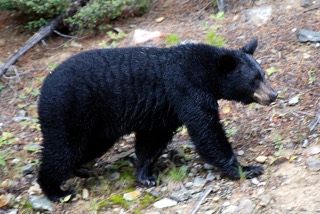 American Black Bear (reference photo)

Species Data
- Classification
- Carnivora / Ursidae Source
- Size
- Males about 120–200 cm, females about 120–160 cm
- Weight
- Males about 60–300 kg, females about 40–150 kg
- Lifespan
- Wild: average about 18 years, record 39 years (some sources put the wild average at about 10 years)
- Diet
- Omnivore Omnivorous, with plant matter making up about 85% of the diet; eats fruit, seeds, and buds as well as insects, fish such as salmon, and occasionally young ungulates. In fall it feeds heavily on fruit and seeds to build fat
- Activity
- Mainly crepuscular, but tends to become more nocturnal near human settlements and more diurnal where it coexists with brown bears
- Distribution
- American black bears are widespread across forested regions of North America, from Canada and Alaska through the continental United States and into parts of Mexico. Source
- Sources
- ja.wikipedia.org en.wikipedia.org
Did You Know?
- American black bears have been shown experimentally to learn visual color discrimination tasks faster than chimpanzees, highlighting their cognitive abilities. Source
- During hibernation, a black bear's metabolic rate drops to roughly a quarter of normal, and because it does not excrete waste, a hardened mass of fecal material forms in the intestine. Source
- American black bears survived the last Ice Age, when larger, more specialized North American bears went extinct, likely because their generalist diet let them exploit a wider range of food sources. Source
Where to See This Species
Operating facilities registered on this site: Japan 1
Fuji Safari ParkShizuokaOpened in 1980
Source links to official sites, official YouTube channels, and news aggregators such as Zoo Ring. Visit the publisher for the full item.
Conservation Story
Conservation Status
Least Concern (LC)
Sources
Support Conservation
A visit is a small, positive way to support the daily lives of the animals you care about.
- Visit
- A visit itself helps support the facility.
- Animal Supporter Programs & Giving
- Find ways to support the facility through its official website.
- Furusato Nozei
- Municipally run facilities may share official guidance for this Japanese hometown-tax program.
FAQ
- What do American black bears eat?
- Their diet is roughly 85% vegetation — berries, nuts, and shoots — supplemented with insects, fish such as salmon, and occasionally young ungulates. Source
- Are American black bears endangered?
- No. The IUCN classifies them as Least Concern, and their total population is estimated to be twice that of all other bear species combined. Source
- How smart are American black bears?
- Quite smart for a large carnivore — experiments have shown they can learn visual color discrimination tasks faster than chimpanzees. Source
- How many operating facilities are registered here?
- Operating facilities registered on this site: Japan 1 Source
Books & gear
Source: ja.wikipedia.org en.wikipedia.org